

A recruiter is about to move a remote software candidate to the final round. The résumé looks plausible, the interview went well, and a reverse image search on the profile photo turns up nothing suspicious. It’s tempting to treat that last result as a small vote of confidence.
What the recruiter actually learned is narrower. The search engine didn’t surface a match for that image. It hasn’t established who is behind the account, whether the work history is real, or who will log in if the company issues credentials.
That distinction matters to hiring teams, but it also matters to anyone vetting a new vendor, responding to a recruiter, or acting on a payment request from an unfamiliar contact. A photo search can uncover a useful clue. The decision still depends on what you can verify independently.
What a clean search actually tells you
A reverse image search can help expose a recycled headshot. If the same image appears on a conference website under a different name, you have something concrete to investigate. But that match still needs context. The conference page may be outdated, the person may have changed their name, or the image may have been reposted without permission.
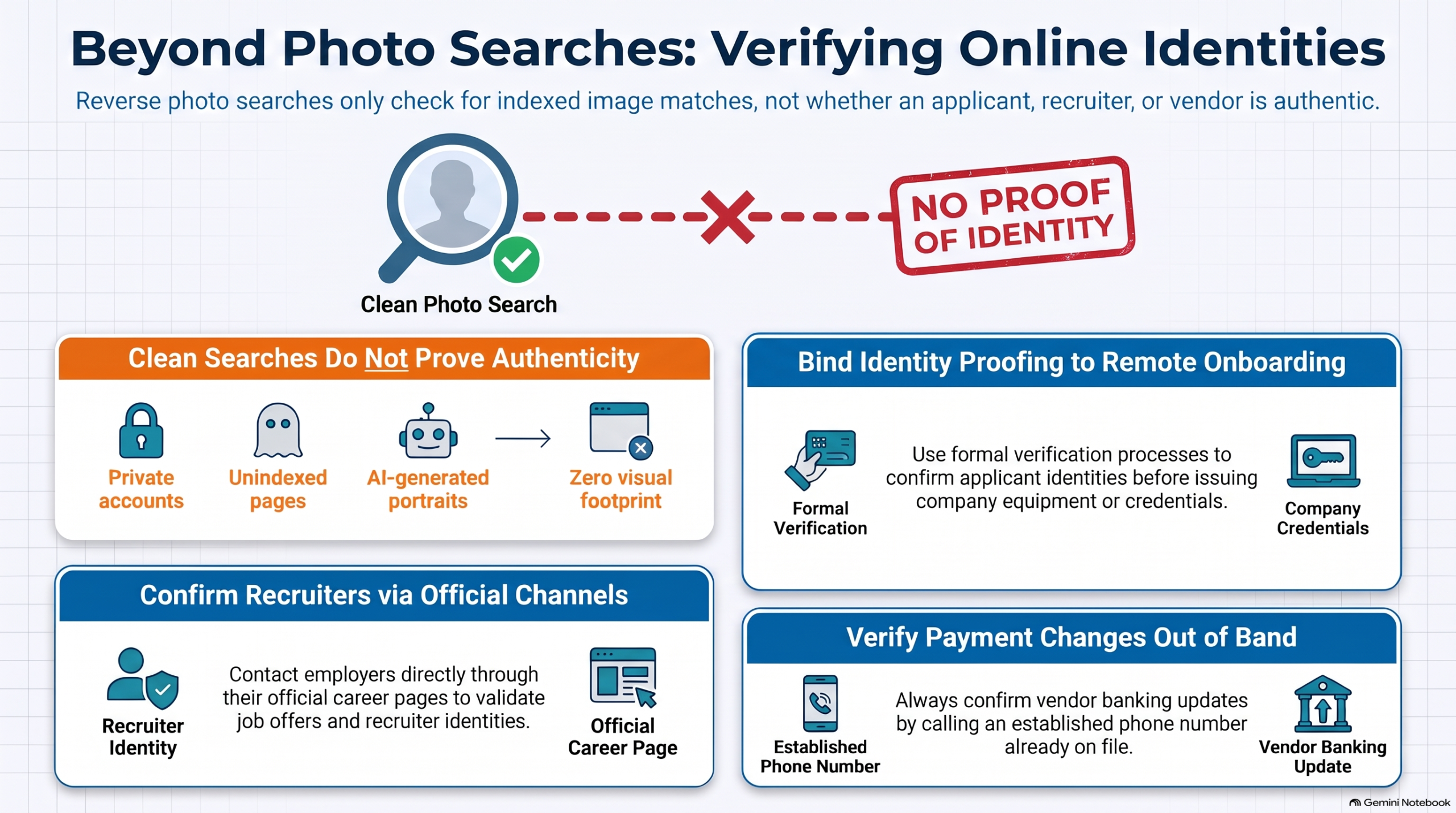
A search with no results has its own limitations. A photo may have come from an account that requires a login, a private group, or a page the search engine hasn’t indexed. A different crop or a different photo of the same person can change what a particular tool returns. And a newly generated portrait may have no earlier copy online to find. A convincing profile can also be built around a real photo belonging to someone with very little public presence.
A face search asks a somewhat different question. It looks for potentially similar faces across different photos within the material the service can search. Face2social, for example, returns possible social media profile matches from an uploaded photo. A result can give a reviewer another lead to check. Similarity alone leaves open whether the accounts belong to the same person and who controls them.
The profile is only one part of the story
In 2022, the FBI’s Internet Crime Complaint Center warned about complaints involving deepfakes and stolen personal information in applications for remote jobs. Some of the reported roles came with access to customer information, financial data, or company systems. The advisory described complaints about possible voice spoofing during interviews and cases in which background checks revealed that personal information submitted by an applicant belonged to someone else. FBI IC3’s 2022 remote-work advisory
A July 2025 FBI alert on North Korean IT workers illustrates how far the deception can extend beyond the application. The FBI described schemes in which U.S.-based individuals provided domestic shipping addresses for company laptops, helping overseas workers bypass controls and obtain access to company networks. Even if the profile picture had looked entirely ordinary, the gap between the person hired and the person accessing the systems would still have mattered. FBI IC3’s July 2025 IT worker alert
Job seekers face a version of the same problem when a purported recruiter contacts them. The FTC reported more than $220 million in job-scam losses in the first half of 2024 alone. That figure covers job scams broadly, including schemes that ask people to put up money to unlock supposed earnings. It shows the scale of the harm from fraudulent job offers. An authentic-looking recruiter profile can make an approach feel credible before the recipient has confirmed the job exists. FTC job-scam data spotlight
Verify the claim that matters
Start by identifying what the person is asking you to trust. A candidate claims a work history. A recruiter claims to represent an employer. A vendor contact claims authority to change where your company sends money. Each claim calls for a different check.
For a recruiter or job offer, go to the employer directly. Find the company’s careers page yourself. If the role isn’t listed, contact the company using details from its official site and ask whether the recruiter and opening are legitimate. A profile, a professional-looking email signature, and a link supplied in the same message all come from the same source.
For a remote hire, connect the interview to onboarding. Use your organization’s approved identity verification process before issuing equipment or granting sensitive access. NIST’s digital identity guidance separates checking that identity evidence is valid from confirming that it belongs to the applicant presenting it. That distinction is useful when a résumé, a photo, and a document all appear to support the same story. NIST SP 800-63A-4
For a vendor payment change, verify the instruction through an established channel. Call a number already on file or confirm the change with a known contact through your existing process. Even a real employee’s profile tells you little about who sent the message or whether the company authorized the change.
If a search turns up a discrepancy, give the person a chance to explain it and apply the same review process to comparable cases. People use different names professionally, keep accounts private, or simply have few public photos. In U.S. hiring, the FTC and EEOC remind employers that federal anti-discrimination rules apply when they use background information in employment decisions, however they obtained it. When employers obtain a background report from a company in the business of compiling such information, the Fair Credit Reporting Act adds requirements. Joint FTC/EEOC guidance for employers
When documenting a review, write down what each check established. “No match surfaced in the photo search” is a useful record. “Verified” belongs next to the claim you actually confirmed, such as the employer acknowledging the recruiter or a known vendor contact confirming new payment instructions. That small distinction can keep an inconclusive search from becoming the basis for a hiring, access, or payment decision.
About the Author

Sydney Noland is Head of Content at Socialprofiler and Face2social. She researches fake identities and practical ways to verify claims using publicly available information.
Video Overview
Follow Brilliance Security Magazine on LinkedIn to ensure you receive alerts for the most up-to-date security and cybersecurity news and information. BSM is cited as one of Feedspot’s top 10 cybersecurity magazines.