

By Sam Lyne
A paper record is often least supervised at the point an organisation believes it has finished with it.
While active, it usually has a home and an owner. An employee file sits with HR, an invoice moves through finance and a customer form belongs to a defined process. Once somebody marks it for disposal, that structure can dissolve surprisingly quickly. The language changes from personal data to confidential waste, but the ink on the page remains exactly where it was.
Secure document disposal is the controlled journey from authorisation to irreversible destruction. It includes the decision to dispose of a record, the container it enters, any temporary storage, collection, transport, shredding and the handling of the resulting paper. Viewing disposal as a process forces an organisation to account for the period in which a record has left active use but can still be read, copied, photographed or removed.
UK data protection law, including the UK GDPR and Data Protection Act 2018, requires personal information to be kept securely and no longer than necessary. It does not provide one universal retention period for every paper record. Organisations need their own retention schedule, based on the purpose of the information and any legal or operational obligations, with clear authority for approving destruction.
Where the disposal gap opens
Bins are deceptively persuasive. Once a document has been dropped inside, people tend to regard it as gone. A locked console or confidential waste sack is only temporary storage, however, and the information remains recoverable until destruction takes place.
The weak points are usually ordinary parts of office life rather than exceptional events:
| Stage | Common failure | Useful control |
| Disposal decision | An employee guesses that an old record is no longer needed | A practical retention schedule and named approval role |
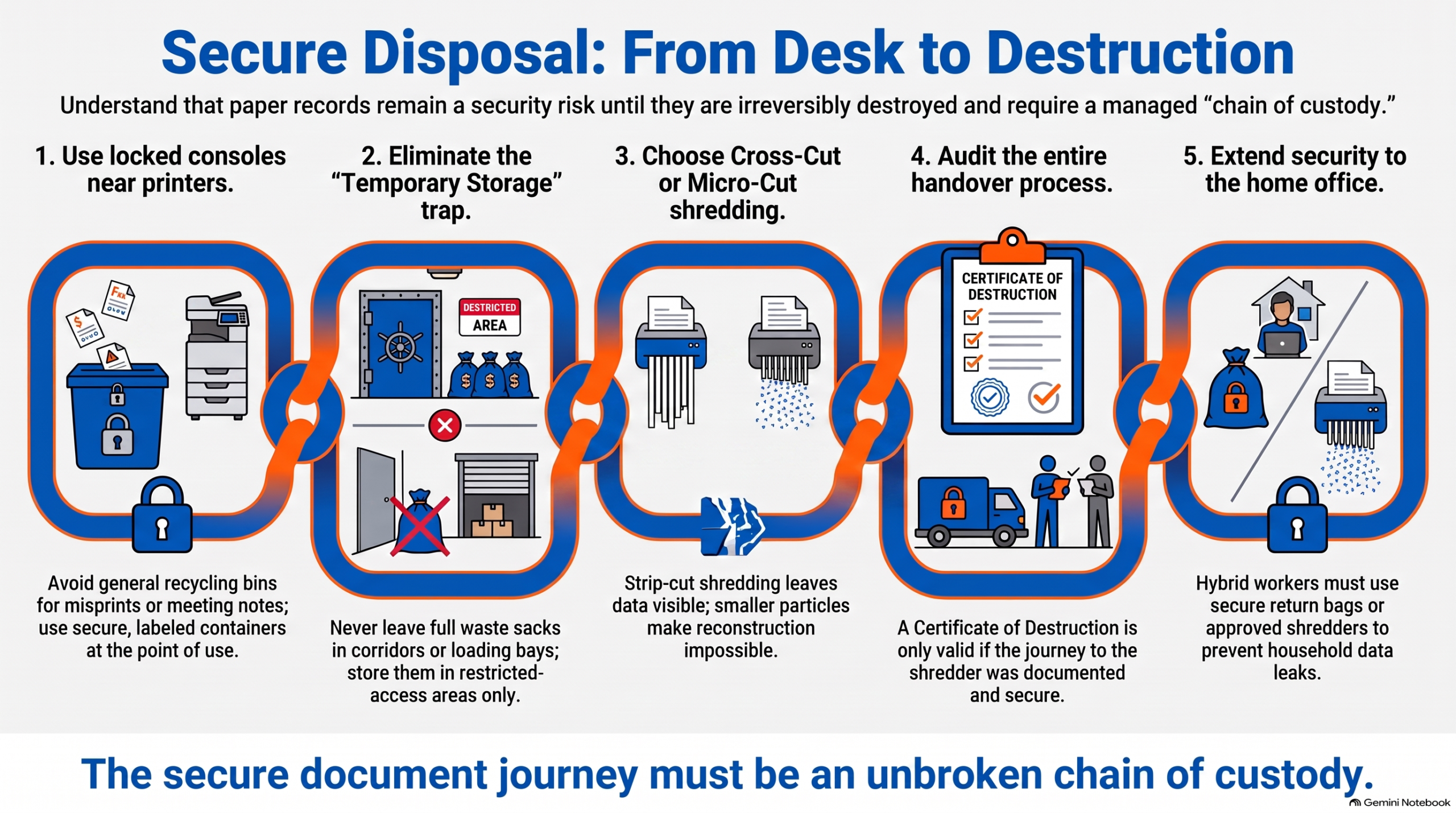
| Internal collection | Paper enters general recycling or an open bag | Locked, clearly labelled secure containers near the point of use |
| Temporary storage | Full sacks wait in a corridor, cupboard or loading area | Restricted storage with responsibility assigned to a specific team |
| Handover | Nobody records when confidential waste leaves the premises | A documented collection and chain of custody |
| Destruction | The shredding method is unsuitable for the sensitivity of the record | Cross-cut or micro-cut shredding, or an assessed destruction service |
| Recycling | Shredded paper is left accessible before collection | Secure containment until it enters the recycling process |
Printers are a frequent source of this disposal gap. A duplicate payslip, jammed customer letter or meeting pack covered in handwritten notes may never enter the filing system at all. It can move from the output tray to general recycling within minutes.
Confidential waste containers placed near shared printers and meeting rooms give these short-lived documents a secure route without relying on staff to carry them across the building.
Office moves and staff departures create the same problem at a larger scale. Several years of financial documents, confidential employee data and forgotten customer files can surface in one afternoon. The capacity that works during an ordinary week may be overwhelmed, leaving boxes or sacks to accumulate wherever space is available.
Clear-outs need additional secure containers, an agreed holding area and somebody capable of separating records that can be destroyed from those still covered by retention requirements.
In-house shredding has to work in the real office
On-site shredding can remove the waiting period and keep destruction under direct control. The equipment still has to work in the setting where it will be used. Security level is important, but so are sheet capacity, duty cycle, bin size, location and the ability to deal with staples or paper clips.
Suitable document shredding equipment should handle the volume of confidential papers produced without repeatedly overheating or requiring constant attention. If a shredder stops after a small batch, employees will create a pile beside it and promise to return later. If it is kept in a room that is rarely accessible, unwanted records will find a more convenient destination.
Strip-cut shredders produce long sections on which names, account details or fragments of financial information may remain visible. Cross-cut and micro-cut techniques reduce documents into much smaller particles and make reconstruction more difficult.
The ICO recommends documenting the disposal method, storing physical records awaiting destruction securely and keeping track of their location. The choice of shred should follow the sensitivity of the material rather than assuming every machine offers equal protection.
Shredded documents also need appropriate handling. Paper may be recyclable waste, but bags of shredded material should not be abandoned in an accessible area while awaiting collection.
Outsourcing extends the chain of custody
Large archives or regular volumes of business confidential waste may justify a professional shredding service. Both on-site shredding, where mobile equipment is brought to the premises, and off-site shredding can be secure when the handover is properly controlled.
The organisation needs visibility over secure collection, temporary storage, transport and destruction. This includes the use of sealed containers, the people authorised to handle them and the time that passes before the documents are destroyed. Where the supplier acts as a data processor, the contractual arrangements should also cover security and accountability.
BS EN 15713:2023 is the current code of practice for the secure destruction of confidential and sensitive material. It covers collection, storage, transportation, destruction methods and certification, making it a useful reference when assessing a disposal service.
A certificate of destruction records the completion of the service and can support an audit trail. It does not reveal whether a bag was left unattended before collection or whether an internal storeroom was accessible for several days. Its value comes from closing a chain of custody that was already secure.
Hybrid working changes the paper trail
At home, there may be no confidential waste console, facilities team or scheduled collection. Printed customer information can end up beside household post, while notes from a sensitive call remain in a drawer for weeks because the employee is unsure how to dispose of them.
Remote-working procedures need to provide a usable answer. Depending on the role, an organisation may restrict home printing, provide a suitable shredder, issue confidential waste bags for secure return or require physical documents to be stored in a locked location. Misprints, duplicated pages and handwritten notes should be included because a single sheet can contain enough personal information to contribute to identity theft or fraud.
Follow one record from beginning to end
A practical review begins with a real type of document rather than the wording of the disposal policy. Follow an employee record, bank statement or customer form from the point at which destruction is authorised. Check the route to the nearest secure container, the arrangements for overflow, the temporary storage location, the collection process and the evidence produced after destruction.
This exercise gives document disposal procedures a useful reality check. It can expose a shredder that cannot cope with demand, confidential waste sacks beside a rear entrance or a collection process whose ownership changes between departments. It also shows whether remote staff have been given a genuine disposal route or simply told to “be secure”.
A reliable disposal process should leave no point at which responsibility becomes unclear. If the organisation cannot account for where a record is held, who can access it and when it will be destroyed, that record has not yet been disposed of securely.
Additional Resources
Video Overview
Infographic
Audio Deep Dive
Follow Brilliance Security Magazine on LinkedIn to ensure you receive alerts for the most up-to-date security and cybersecurity news and information. BSM is cited as one of Feedspot’s top 10 cybersecurity magazines.