

As remote and hybrid work become more common, many organizations adopt bring-your-own-device (BYOD) programs to give employees greater flexibility while supporting productivity. A well-designed BYOD policy helps establish clear expectations around device use, data protection and access controls.
However, failing to address key details during the policy creation process can expose organizations to unnecessary risks. Understanding the common mistakes behind ineffective BYOD policies can help IT leaders create stronger security practices.
1. Overlooking Data Protection, Access Controls and Privacy Expectations
Research on BYOD practices in hospitals found that 70% of surveyed organizations allowed staff to use personal laptops and tablets for work. As the use of personal devices expands across professional environments, organizations face greater challenges in protecting sensitive data and ensuring only authorized users can access it.
Personal devices often contain a mixture of personal and business information, making data protection a critical part of any BYOD strategy. Without appropriate safeguards, sensitive company information may remain accessible when devices go missing, change hands or fall victim to cyber threats. Employees may also unintentionally store business files alongside personal content, increasing the risk of accidental exposure or unauthorized sharing.
Stronger access controls within a BYOD policy help limit access to only the information employees need for their role, reducing unnecessary exposure across personal devices. Clearly defining who can view, edit or share business information also helps organizations maintain better oversight as employees work from multiple locations and devices.
Organizations also need to balance security with employee privacy. Staff may have concerns about the visibility IT teams have into their personal devices. Clearly communicating what information IT teams can monitor and how safeguards protect personal data helps build trust while supporting responsible BYOD practices.
2. Failing to Define BYOD Security Requirements
A BYOD policy should provide employees with clear guidance on how they can use personal devices for work purposes. A common mistake is creating a policy that focuses mainly on convenience while leaving cybersecurity expectations unclear.
Without defined security requirements, employees may use weak passwords, delay software updates or connect to unsecured networks without realizing the potential risks. IT leaders should outline the minimum security standards for personal devices, including password protection, operating system updates, antivirus requirements and secure access methods.
The policy should also clarify which devices, operating systems and applications employees can use. Without clear boundaries, employees may assume they can use any personal device or application for business activities, creating security gaps that IT teams struggle to monitor.
For example, IT teams often treat BYOD devices as unmanaged systems that require additional safeguards to protect company resources. They may utilize multifactor authentication at every login to verify identity when employees use personal devices to access work systems. Setting clear requirements allows organizations to support flexible device use while maintaining greater control over their digital environment.
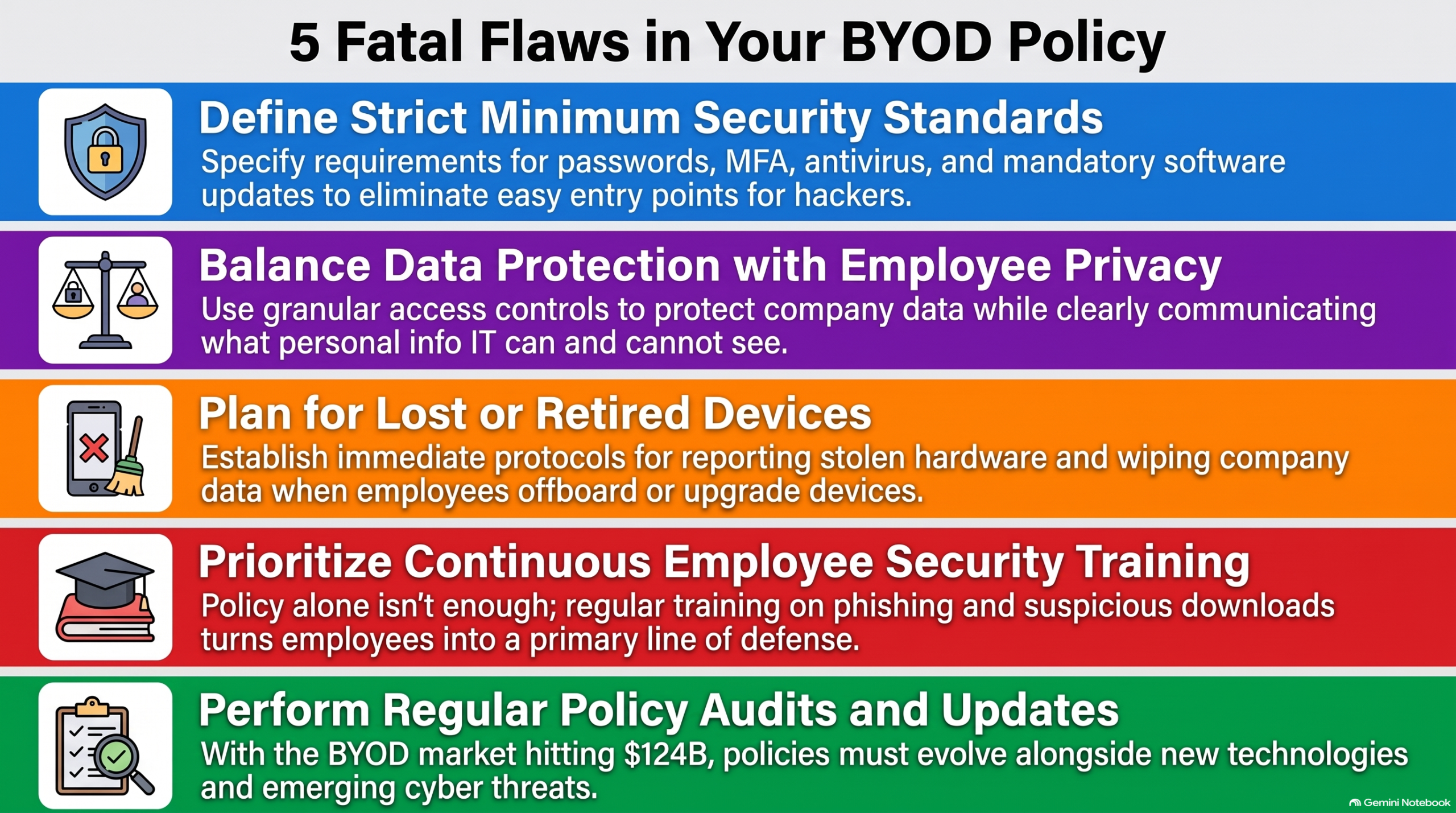
3. Not Planning for Lost, Stolen or Retired Devices
Employees can lose, replace or sell devices, creating significant risks of unauthorized access to company information. However, some BYOD policies fail to explain what should happen when a device is no longer secure.
A comprehensive policy should include procedures for reporting lost or stolen devices, removing company data and disconnecting devices that don’t meet security requirements. Employees should understand the steps they need to take immediately if a security breach compromises a device containing business information.
Organizations should also consider how to terminate access when employees leave the company or stop using a personal device for work. Clear offboarding procedures help prevent former users or unauthorized parties from accessing company systems. Preparing for these situations allows organizations to respond faster and reduce the impact of potential security incidents.
4. Neglecting Employee Training and Awareness
Even the most detailed BYOD policy can fail if employees do not understand how to follow it.
Employees should receive guidance on common security risks, such as phishing attempts, unsafe downloads, suspicious login requests and the importance of keeping devices updated. Training should also cover system-level threats such as distributed denial-of-service attacks, which can create opportunities for other attacks by overwhelming a network with traffic.
Cybersecurity depends on everyday decisions, making employee awareness an important part of any BYOD approach. When employees understand how their actions affect company security, they become a stronger part of the organization’s overall defense strategy. Regular training can reinforce secure habits and ensure employees understand why certain requirements exist.
5. Lacking Regular Policy Reviews and Updates
The global BYOD market reached $124 billion in 2026 as hybrid work expanded and companies trimmed hardware costs. With more organizations adopting personal devices to support flexible work arrangements, IT leaders need to ensure their BYOD policies continue to address changing security requirements and operational needs.
Organizations often make the mistake of treating the policy as a one-time document that they rarely revisit. A BYOD policy that proved effective when organizations first introduced it may become outdated as employees adopt new devices, organizations introduce new tools and security risks change.
IT teams should review BYOD policies periodically to ensure they reflect current technologies, business requirements and security practices. Organizations may need to update their policies when they introduce new systems or respond to emerging threats. Keeping policies current helps maintain stronger protection while supporting the changing ways employees work.
Build a Stronger Foundation for BYOD Security
A successful BYOD policy requires organizations to consider both the opportunities and responsibilities that come with personal device use. By establishing clear expectations and aligning security practices with evolving workplace needs, IT leaders can ensure that device flexibility remains a secure advantage.

As the Features Editor at ReHack, Zac Amos writes about cybersecurity, artificial intelligence, and other tech topics. He is a frequent contributor to Brilliance Security Magazine.
Additional Resource
Video Overview
Follow Brilliance Security Magazine on LinkedIn to ensure you receive alerts for the most up-to-date security and cybersecurity news and information. BSM is cited as one of Feedspot’s top 10 cybersecurity magazines.