

Citizens routinely share highly sensitive information with government agencies, from Social Security numbers and tax records to health data and benefits applications. As cyberthreats evolve and become more sophisticated, public sector organizations face pressure to abandon outdated communication methods, such as standard email attachments and unsecured file transfers. Protecting sensitive citizen data requires a shift toward secure messaging platforms designed to address modern threats.
The Growing Threat to Citizen Information
Some government agencies still rely on older communication systems that may not provide the level of protection sensitive data requires. Standard email attachments and basic file-sharing tools may lack the encryption, authentication and access controls needed for sensitive data. An unsecured attachment containing a Social Security number or medical record can be intercepted in transit, sent to the wrong recipient, or left sitting in an inbox indefinitely without an expiration date or access limits.
Agencies can fall out of step with data protection requirements without experiencing a major breach. It happens through the routine use of tools that fail to meet modern security standards. Small vulnerabilities add up over time, creating a risk that regulatory audits will eventually uncover them.
Transitioning From Cybersecurity to Cyber Resilience
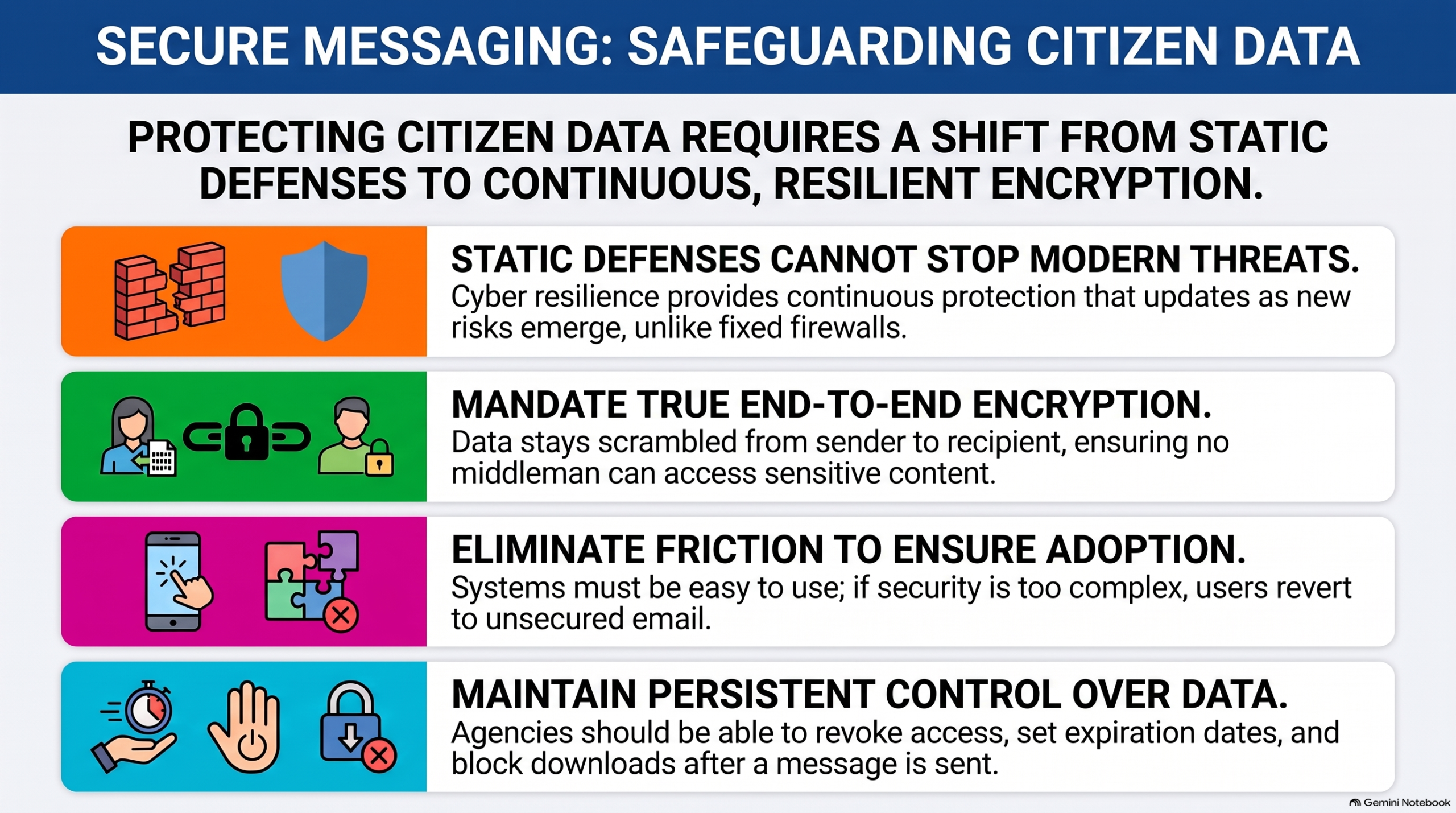
Static defenses have a built-in limitation. A fixed set of protections, like a single firewall setup, can only block the threats it was designed to catch when it was first built. As hackers develop new attack methods, static systems become less effective without continuous updates.
Cyber resilience takes a different approach. Instead of treating security as a one-time installation, it offers protection that continuously updates as new risks emerge. This matters especially for citizen-facing services, where agencies cannot take systems offline to install patches. It requires continuous protection that builds cyber resilience into electronic documents rather than defenses that stay frozen after deployment.
Core Mechanics of Secure Messaging and Data Protection
Multiple layers of technology work together to protect sensitive communications. A firewall acts as the first line of defense, filtering traffic entering and leaving a network so unauthorized attempts get blocked. Think of it as a gatekeeper that checks every visitor against a list of approved entries.
An intrusion detection system adds another layer. This monitoring tool watches for suspicious activity that slips past the firewall, looking for red flags like repeated failed login attempts or unusual data transfers.
Encryption protects the data itself. Even if someone intercepts a message, strong encryption keeps the content unreadable without the correct decryption key. Network security extends to protecting data in transit and at rest, with weak security leading to serious financial and reputational damage.
The Role of End-to-End Encryption
End-to-end encryption provides a high level of protection for sensitive communications. This method scrambles a message before it leaves the sender’s device and unscrambles it only when it reaches the intended recipient. The key that unlocks the message never travels with it, and any servers that relay the message only see the scrambled version.
Without end-to-end encryption, each stop along the route represents a potential weak point where someone could access the content. Weaker methods might secure a message only while it travels, but if it gets stored improperly or forwarded without proper controls, the data becomes exposed. True end-to-end encryption protects the message at every stage.
Modernizing Public Sector Communications
Government agencies face a unique challenge when rolling out secure communications. Reaching a diverse population means supporting multiple channels like email, text, mobile apps and web portals, not just one fixed method.
Granicus delivers engagement cloud and digital communication solutions that manage this kind of outreach at scale across thousands of government entities. The security behind that scale keeps evolving, with shifts toward passkeys rather than traditional passwords, demonstrating how large systems can strengthen security while remaining accessible.
Reducing Friction in Secure Digital Exchange
Usability determines whether secure messaging actually gets used. When a system feels too complicated, people often find workarounds. A citizen who faces too many steps may go back to regular email, which defeats the purpose of having secure options available.
DataMotion provides secure message center solutions that plug directly into existing tools like portals, customer management systems and contact centers. The platform eliminates the need for account creation and software downloads for recipients. Someone can receive a protected message as easily as a regular one.
The DataMotion platform supports compliance with regulations like HIPAA, CJIS and PCI DSS through its built-in security features. It helps organizations meet these requirements more easily, though compliance depends on how they set up and use the system and on their own security policies.
Enforcing Policy and Regulatory Compliance
Requirements and security frameworks such as FedRAMP influence how government agencies evaluate the cloud services that handle citizen data. FedRAMP focuses on standardized security authorization for cloud products used by federal agencies, while other privacy and cybersecurity requirements may govern how sensitive information is encrypted, accessed, retained and shared.
Virtru provides persistent data control capabilities in which protection applies to the information itself rather than only to the network through which it travels. Organizations can revoke access to a document, set expiration dates, or block forwarding and downloading. These lasting controls help meet strict compliance standards.
Safeguarding the Future of Public Services
Digital interactions between citizens and government agencies will continue to grow as more services move online. Putting strong, easy-to-use secure messaging in place is essential for keeping public trust. The platforms that succeed will combine solid technical protection with experiences simple enough that security becomes the natural choice rather than an obstacle.

As the Features Editor at ReHack, Zac Amos writes about cybersecurity, artificial intelligence, and other tech topics. He is a frequent contributor to Brilliance Security Magazine.
Additional Resource
Video Explainer
Follow Brilliance Security Magazine on LinkedIn to ensure you receive alerts for the most up-to-date security and cybersecurity news and information. BSM is cited as one of Feedspot’s top 10 cybersecurity magazines.