

A message arrives from someone claiming to recruit for a well-known company. The opportunity sounds plausible, the profile looks professional, and a reverse image search on the recruiter’s photo turns up nothing suspicious.
That result can feel reassuring. But the search hasn’t established whether the person represents the employer, whether the opening exists, or who controls the account.
The same uncertainty applies when a new vendor contact introduces themselves or asks your finance team to update payment instructions. A convincing photo can help a story feel credible. Confirming the story takes additional work.
A photo search can uncover a useful clue. The decision still depends on what you can verify independently.
What an empty search result means
A general reverse image search can help expose a recycled headshot. If a supposed recruiter’s photo appears on another company’s website under a different name, you have a discrepancy to investigate.
That result still needs context. The page may be outdated, the person may use a different professional name, or someone may have reposted the image without permission.
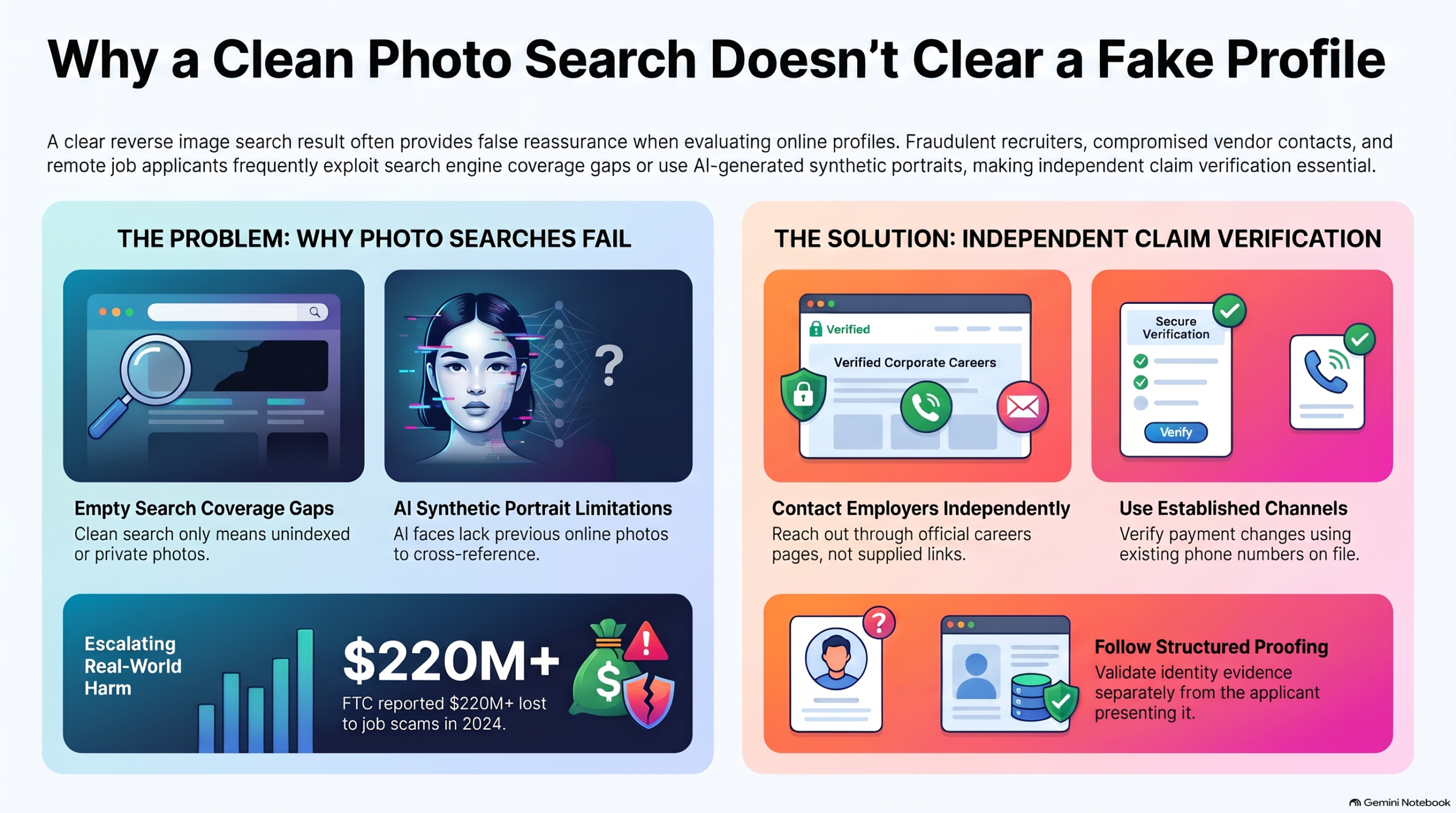
An empty result also needs careful interpretation. Search engines can only return material within their available coverage. A photograph may come from a private account, a page requiring a login, or material the search engine hasn’t indexed. A crop, edit, or different photograph may also affect what a particular search finds.
Someone with a limited public presence may have few searchable images. A fraudulent account can exploit those gaps by using a stolen photograph that a general search fails to locate.
The practical meaning of a clean search is limited. The tool didn’t surface a match within the material it could search.
When a different photograph provides a lead
Specialist face-search tools can provide an additional lead when a general image search is inconclusive. Face2social, for example, compares facial characteristics to look for possible profiles on Instagram, Facebook, TikTok, LinkedIn, and X. It can return possible matches using different photographs of the same person. The exact uploaded image does not need to exist online.
Results depend on the publicly available images the service can search, and coverage is incomplete. Each possible match requires independent verification. A match alone cannot establish who controls an account, and an empty result cannot verify it. Face2social must not be used for employment decisions.
Consider a profile using a photograph taken from a source unavailable to search. Another public account might contain a different photograph of the person whose image was stolen. Comparing facial characteristics could provide a lead between those images.
That example follows from the matching method. Whether a useful result appears depends on the available images and the search itself. Reviewers still need to establish the relationship between the accounts and investigate the claim that prompted the search.
Synthetic faces create a separate problem
An AI-generated portrait introduces a different limitation. A fully synthetic face may have no earlier photograph or real person behind it for a search to identify.
Face2social’s documented capability is finding possible facial matches. It should not be treated as an AI-image detector or as a way to establish a real identity behind a fully synthetic face.
For the person reviewing a suspicious account, this means the investigation must extend beyond the portrait. Even determining that a photograph depicts a real person would leave unanswered whether that person controls the account or authorized the message.
The account’s claims, contact details, and requests provide other opportunities for verification.
The consequences extend beyond the profile
The FBI’s Internet Crime Complaint Center warned in 2022 about complaints involving deepfakes and stolen personal information in applications for remote jobs. Some reported positions involved access to customer information, financial data, and company systems. The advisory described possible voice spoofing during interviews and cases in which applicants submitted information belonging to someone else. FBI IC3’s remote-work advisory
A July 2025 FBI alert on North Korean IT workers described deception extending into equipment delivery and network access. U.S.-based individuals provided domestic locations for company laptops, helping overseas workers circumvent controls and gain access to company networks. These cases illustrate why organizations need identity and access controls throughout onboarding. FBI IC3’s IT worker alert
Job seekers also face substantial harm from fraudulent opportunities. The FTC reported more than $220 million in job-scam losses during the first half of 2024. That figure covers job scams broadly, including schemes that require people to deposit money to unlock supposed earnings. A professional-looking recruiter profile can help an approach appear credible before the recipient confirms that the job exists. FTC job-scam data spotlight
Verify the claim behind the request
Begin with what the person is asking you to trust. A recruiter claims to represent an employer. A vendor contact claims authority to change payment instructions. A remote applicant claims a particular identity and work history. Each claim calls for evidence suited to the decision.
For a recruiter or job offer, contact the employer independently. Find the company’s careers page yourself. If the opening is missing or the contact seems questionable, use contact information from the official company website to ask whether the recruiter and opportunity are legitimate. A profile, email signature, and website link supplied in the same message all originate with the person making the claim.
For a vendor payment change, use an established channel. Confirm the instruction through a known contact or a telephone number already on file. Follow your organization’s approval process before changing banking details. A recognizable face or genuine employee profile cannot establish who sent a particular message.
For hiring and onboarding, follow approved verification procedures. Use processes appropriate to the role before issuing equipment or granting sensitive access. NIST’s digital identity guidance distinguishes validating identity evidence from verifying that it belongs to the applicant presenting it. That distinction helps explain why apparently consistent documents and personal details still require a structured review. Face2social’s prohibition on employment decisions applies regardless of an employer’s broader screening procedures. NIST SP 800-63A-4, Identity Proofing and Enrollment
Employment reviews also carry specific responsibilities. The FTC and EEOC explain that federal anti-discrimination requirements apply when employers use background information in employment decisions, regardless of how they obtained it. When an employer obtains a background report from a company in the business of compiling such information, the Fair Credit Reporting Act adds requirements. Joint FTC/EEOC guidance for employers
Throughout any review, document what each check established. “No match surfaced in the photo search” accurately records a search result. Confirmation that an employer recognizes a recruiter or that a known vendor contact authorized new payment instructions supports a specific business decision.
Keeping those findings precise helps prevent an inconclusive photo search from becoming a reason to trust an unfamiliar account.
About the Author

Sydney Noland is Head of Content at Socialprofiler and Face2social, a face search tool that finds social media profiles by photo. She researches fake identities and practical ways to verify claims using publicly available information.
Video Overview
Follow Brilliance Security Magazine on LinkedIn to ensure you receive alerts for the most up-to-date security and cybersecurity news and information. BSM is cited as one of Feedspot’s top 10 cybersecurity magazines.