

While healthcare consolidation in New Jersey aims to streamline operations and reduce costs, it unintentionally creates massive, interconnected targets for cybercriminals. As hospital systems merge and share IT infrastructure, addressing unique cybersecurity vulnerabilities created by unification becomes critical. These larger networks bring exponentially larger attack surfaces and compounding security risks.
The Growing Wave of Hospital Consolidation in New Jersey
The rapid pace of hospital mergers and acquisitions in New Jersey has fundamentally reshaped the state’s healthcare landscape. What was once a collection of independent facilities has consolidated into a handful of powerful health systems controlling the majority of patient care.
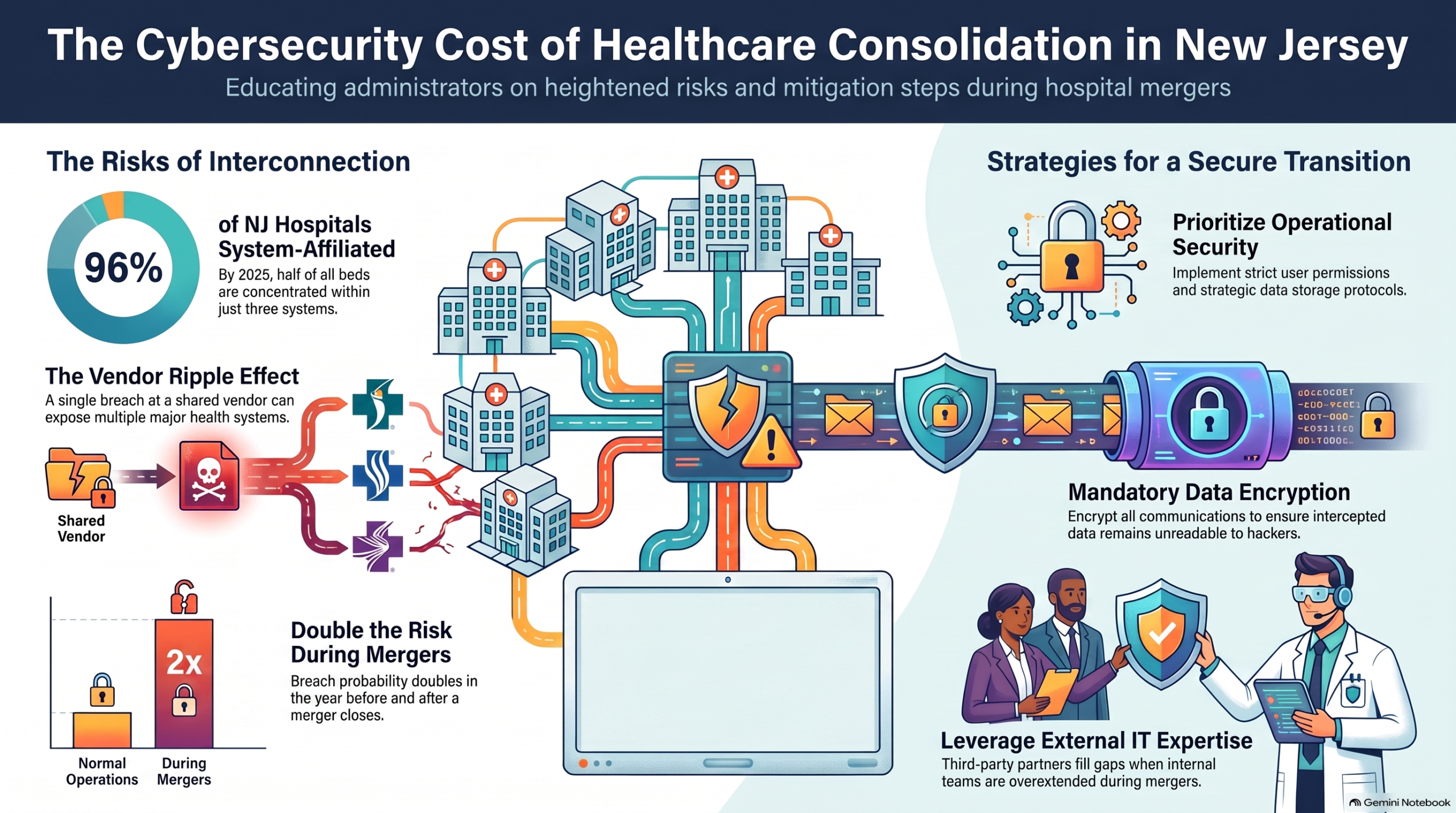
This consolidation extends beyond full mergers. Joint operating agreements, shared services and affiliation deals blur the line between independent and system-affiliated hospitals without requiring a complete change in ownership. By 2025, 96% of New Jersey hospitals were system-affiliated, with half of all staffed beds concentrated within the three largest hospital systems. This concentration of power brings economies of scale, but it also creates unprecedented cybersecurity challenges.
Concentrated Networks and Shared Vendors
Merging massive hospital networks forces organizations to integrate clinical systems and share IT infrastructure across dozens of facilities. Patient records, billing systems and operational databases must communicate seamlessly between locations that may have operated independently for decades.
Shared vendors extend far beyond core IT infrastructure. Billing processors, legal counsel and administrative service providers create additional connection points where a security gap in any one relationship can ripple across every system it touches. When a shared vendor or service provider experiences a breach, every connected health system may face exposure.
Ascendant Technologies, Inc., a managed IT provider in New Jersey experienced in cybersecurity consulting, believes that protecting integrated networks relies on operational security, which involves “setting user permission levels and deciding how and where to store data.”
A Wake-Up Call From the Greenbaum Law Firm Attack
A recently disclosed cybersecurity incident involving a New Jersey law firm illustrates how third-party relationships can expose healthcare information outside a hospital’s own systems.
Greenbaum Rowe Smith & Davis LLP reported that personnel discovered unauthorized access to its systems through a compromised user account on November 27, 2025. The firm’s investigation determined that an unauthorized third party acquired certain information during activity that occurred between November 25 and 27.
The U.S. Department of Health and Human Services breach portal lists the incident as affecting 12,801 individuals. Greenbaum’s notice said the affected information included names, addresses, and health information such as medical record and account numbers, diagnoses, treatment information, provider information, dates of service, medical costs, and health insurance information. Social Security numbers and dates of birth may also have been involved for a subset of individuals.
Atlantic Health publicly confirmed that certain patient information associated with its relationship with Greenbaum was affected. Published reports have also identified Hackensack Meridian Health and Trinitas Regional Medical Center among the healthcare organizations whose patient information may have been involved.
Greenbaum stated that, at the time of its notice, it had found no evidence that the information had been published or misused and was not aware of related identity theft or fraud. Nevertheless, the incident demonstrates how patient information held by an outside professional-services provider can create risk beyond a healthcare organization’s directly controlled network. When multiple providers entrust sensitive information to a common third party, a security incident at that organization can affect patients across multiple institutions.
Shielding Patient Data During IT Integrations
Merging hospitals need external expertise to safely integrate disparate systems without creating security gaps. Internal IT teams are often stretched thin during mergers, simultaneously maintaining day-to-day operations and managing the technical demands of combining systems. This is where outside expertise fills critical gaps. Cybersecurity guidance can help health systems identify access disparities, secure vendor connections and prioritize protections before newly integrated systems create avoidable exposure.
Ascendant emphasizes that bringing in experienced IT partners during these transitions helps organizations “determine what they can use to streamline processes and how to implement them into current systems seamlessly.” This guidance becomes essential when legacy systems from different hospitals must communicate securely while administrators phase out redundant infrastructure.
Preventing Breaches With Encrypted Communications
Beyond user permissions, data must be protected while in transit, especially when communicating with third-party vendors like law firms. Encryption is especially critical for routine correspondence with external partners. Sensitive patient data often moves through email exchanges that aren’t always subject to the same scrutiny as core clinical systems.
Ascendant notes that implementing a critical defense layer through encryption can “prevent data from being readable to outside parties.” This helps ensure that even if a message is intercepted or accessed through a compromised account, the protected health information remains unreadable without proper decryption credentials.
The Timeline of Vulnerability During Integrations
Cyber risk persists throughout the integration process as legacy systems are phased out. Research shows that a hospital’s risk of a data breach doubles in the year before and after a merger closes, primarily due to hacking incidents during IT integration.
This elevated risk window often coincides with distracted staff, delayed security audits and inconsistent protocols across merging organizations. Gaps become easier to miss until systems are fully unified and security measures are standardized across all facilities.
Securing New Jersey’s Consolidated Healthcare Future
New Jersey’s healthcare consolidation creates operational efficiencies, but it also amplifies cybersecurity vulnerabilities that extend far beyond individual hospital walls. Shared vendors, integrated systems and third-party partnerships create interconnected risk that demands proactive security measures throughout every phase of merger activity. Health systems that prioritize secure integrations and comprehensive vendor management can protect patient trust while realizing the benefits of consolidated operations.

As the Features Editor at ReHack, Zac Amos writes about cybersecurity, artificial intelligence, and other tech topics. He is a frequent contributor to Brilliance Security Magazine.
Additional Resource
Video Overview
Follow Brilliance Security Magazine on LinkedIn to ensure you receive alerts for the most up-to-date security and cybersecurity news and information. BSM is cited as one of Feedspot’s top 10 cybersecurity magazines.