

Third-party outsourcing helps expand operational efficiency, but it also introduces new layers of risk across security, compliance and financial integrity. System and Organization Controls (SOC) reports, particularly SOC 1 and SOC 2, help organizations evaluate external service providers through structured, independent assessments. Understanding their differences is essential for effective vendor risk assessment in complex management systems.
What Is the Difference Between SOC 1 and SOC 2 Reports?
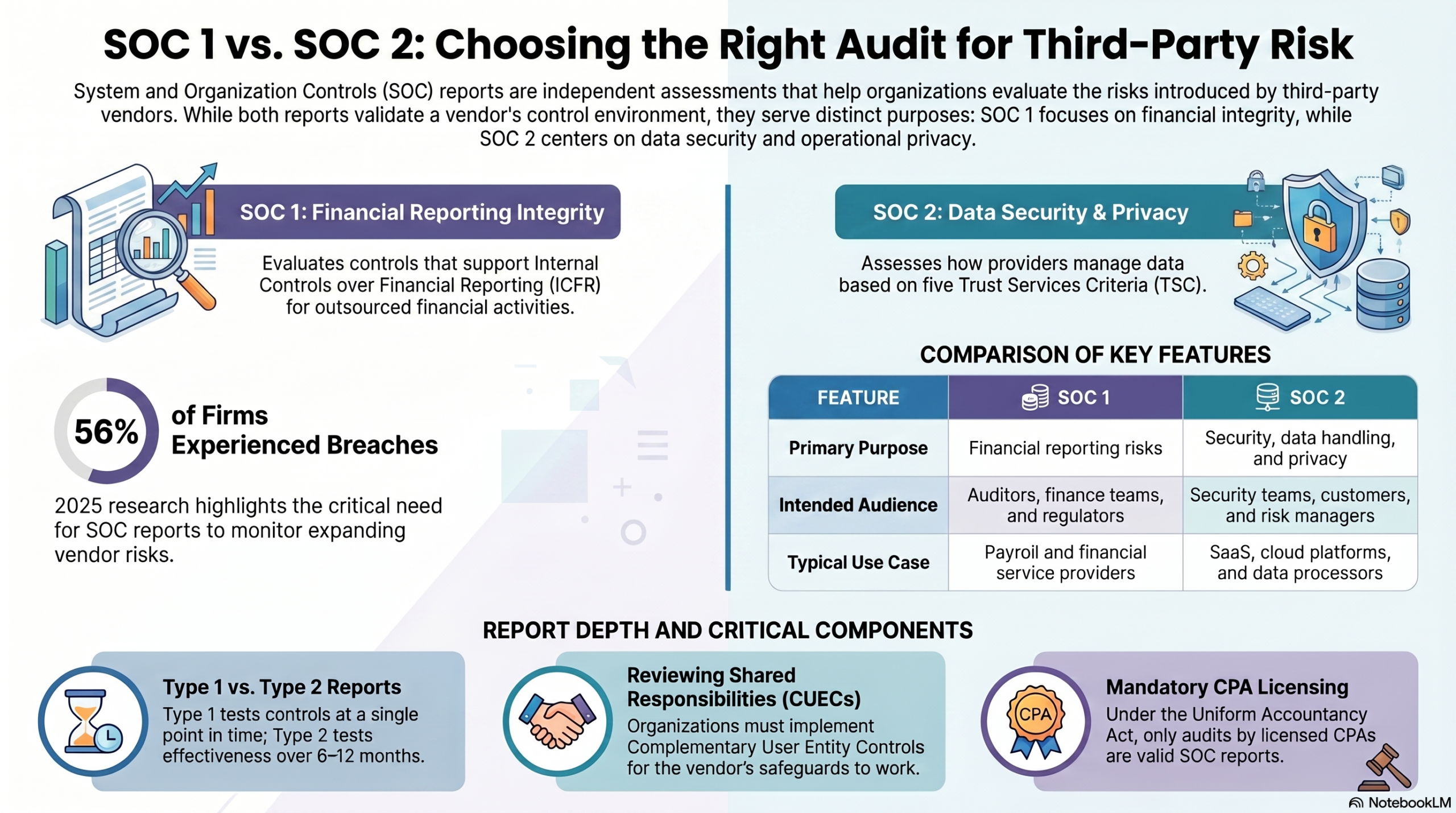
The primary difference between SOC 1 and SOC 2 lies in the controls they assess. SOC 1 addresses financial reporting risks, while SOC 2 addresses information security and operational risks.
SOC 1 reports evaluate controls that support internal controls over financial reporting (ICFR). They are relevant for organizations that outsource financial or transaction-processing activities.
On the other hand, SOC 2 reports assess how service providers manage and protect customer data in accordance with the AICPA Trust Services Criteria (TSC) framework. There are five categories in the TSC framework, including:
- Processing integrity
- Privacy
- Security
- Confidentiality
- Availability
According to BDO, SOC 1 reports are particularly valuable when outsourced services affect financial reporting. Auditors use SOC 1 reports as evidence of service provider controls, so clear SOC 1 reports reduce audit effort and the need for additional testing. SOC 2 reports are a more appropriate component for comprehensive third-party risk management.
SOC 1 and SOC 2 are not mutually exclusive. Many service providers obtain both reports to address different stakeholder needs. Together, they provide a more comprehensive view of financial and security-focused third-party assessments. UVA, for instance, uses SOC 1 for financial operations and payment processing, while SOC 2 ensures its vendors safeguard university data appropriately.
Comparing SOC 1 and SOC 2
Although both reports assure a vendor’s control environment, their objectives and audiences differ significantly.
| SOC 1 | SOC 2 | |
| Purpose | Assess controls impacting financial reporting | Assess controls related to system security, data handling and privacy protection |
| Intended Audience | Auditors, finance teams, management and regulators | Security teams, customers, risk managers and compliance professionals |
| Control Scope | Financial transaction processing and reporting controls | System operations, data protection processes, and security and privacy controls |
| Reporting Criteria | Controls relevant to a user entity’s ICFR | In accordance with TSC’s five categories |
| Use Cases | Payroll providers, financial service organizations and transaction processors | SaaS providers, cloud platforms, data processors and managed service providers |
| Compliance Relevance | Narrowly focused on financial audits and supports ICFR requirements. | Broadly focused on due diligence and security requirements to support various industry regulations. |
Why Do SOC Reports Matter in Third-Party Risk Management?
As vendor relationships expand, organizations face growing exposure to third-party risks. 2025 research found that 56% of 209 respondents experienced third-party breaches in the previous year. These findings highlight the importance of SOC reports in helping organizations evaluate and monitor vendor risks.
SOC 1 ensures service providers have implemented effective controls to protect financial processes and data accuracy. BDO explains that this visibility enables organizations to better manage financial risks that remain their responsibility even when activities are outsourced.
For broader third-party risk management efforts, SOC 2 reports provide insight into a vendor’s cybersecurity, privacy and operational practices. Security teams frequently use SOC 2 reports during procurement reviews, annual vendor assessments and ongoing monitoring activities. The reports help evaluate whether a provider can adequately safeguard sensitive information.
What Are the Key Details in a SOC Report?
A SOC report contains several important components that help organizations understand the scope of a service provider’s controls.
Type 1 vs. Type 2 Reports
SOC reports come in two formats, Type 1 and Type 2, which differ in the depth and duration of evaluation.
- Type 1 evaluates controls at a specific point in time.
- Type 2 evaluates controls over a defined period, typically 6 to 12 months.
Complementary User Entity Controls (CUECs)
CUECs identify responsibilities that customers must implement within their own environments for the service provider’s controls to function effectively. BDO adds that organizations should review these reports carefully to ensure shared control responsibilities are in place.
Complementary Subservice Organization Controls (CSOCs)
CSOCs refer to controls performed by subservice organizations, such as data center operators and network or hosting providers that support the primary service provider. These disclosures help customers understand dependencies on additional third parties within the service delivery chain.
Control Descriptions and Testing Results
SOC reports also include detailed descriptions of individual controls, testing procedures performed by auditors and the results of those tests. These findings provide insight into control maturity and any identified exceptions.
How to Choose Between SOC 1 and SOC 2
Selecting the appropriate report depends on the nature of the services and the risks they introduce. Organizations should request a SOC 1 report when a vendor’s services directly affect financial transactions, accounting processes or financial reporting.
A SOC 2 report is appropriate when evaluating cloud providers, software vendors, managed service providers or any organization that stores, processes or transmits sensitive customer data. Security and compliance teams often prioritize SOC 2 reports because they provide assurance regarding cybersecurity and operational controls.
Amy Pawlicki, Vice President of Assurance and Advisory Innovation at the AICPA, emphasizes that SOC 2 is a formal attestation engagement that complies with the AICPA’s rigorous standards. Under the Uniform Accountancy Act (UAA), only audits by licensed CPAs are valid for SOC reporting.
In some situations, organizations may require both SOC 1 and SOC 2 reports if a service provider impacts financial reporting while also handling sensitive systems or customer data. Whichever report an organization chooses, it should ensure that licensed CPAs prepare the report and address the relevant financial and security risks.
Strengthening Third-Party Oversight With SOC
SOC reports are essential for assessing different dimensions of third-party risk. While SOC 1 focuses on controls that influence financial reporting, SOC 2 evaluates the security and operational safeguards that protect systems and information. Understanding the differences between these reports enables organizations to perform more effective vendor evaluation while supporting financial integrity and data security.

Devin Partida is a frequent contributor to Brilliance Security Magazine, an industrial tech writer, and the Editor-in-Chief of ReHack.com, a digital magazine for all things technology, big data, cryptocurrency, and more. To read more from Devin, please check out the site.
Additional Resource
Video Overview
Follow Brilliance Security Magazine on LinkedIn to ensure you receive alerts for the most up-to-date security and cybersecurity news and information. BSM is listed among Feedspot’s top 10 cybersecurity magazines.