

Knowing what to look for when choosing managed IT support services can shape a company’s cybersecurity, daily operations and ability to grow. Many businesses lean on outside providers to protect sensitive data and respond to threats that internal teams may lack the resources to handle. A smart selection starts with a close look at security depth, access controls and the measurable outcomes a provider can support.
Security Posture and Compliance Expertise
Cybersecurity capability deserves a top spot on any provider checklist because attackers continue to target businesses through phishing and system vulnerabilities. The Federal Bureau of Investigation’s 2025 Internet Crime Report tallied over 1 million complaints of suspected internet crimes and ranked phishing and spoofing among the top three reported cyberthreats.
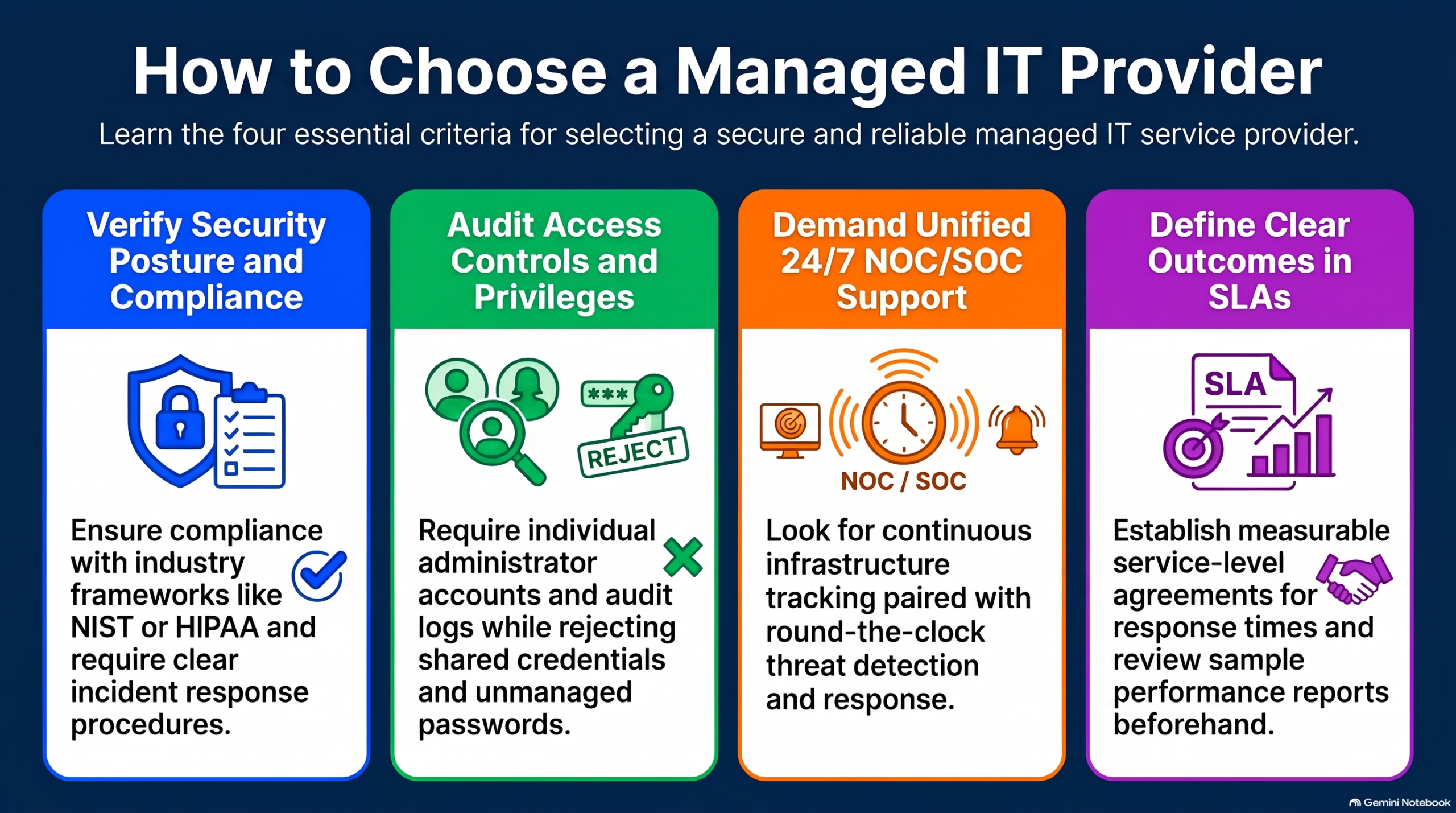
A provider’s security track record and incident response procedures show how it may handle data under pressure. It also helps to ask how a provider demonstrates the controls that protect its systems and whether it understands the regulations and frameworks that match a client’s industry and compliance obligations, such as the Health Insurance Portability and Accountability Act or the National Institute of Standards and Technology (NIST) Cybersecurity Framework.
Access Control and Privilege Management Practices
Managed IT providers often receive privileged access to client networks and sensitive information, so their internal access controls play a major role in preventing unauthorized activity. A useful first question is whether technicians use individual administrator accounts and whether audit logs record administrative actions.
According to Sikich, a global professional services firm providing cybersecurity managed services, warning signs include admin accounts shared across multiple technicians, with no record of who accessed what, and shared password managers that store credentials without access restrictions. These practices could expose several client environments to a single breach, which makes shared credentials and weak password storage clear red flags.
24/7 Proactive Monitoring and Support
Providers that deliver 24/7 managed IT support services rely on continuous monitoring to detect suspicious network activity and emerging vulnerabilities before they cause extended downtime or major security incidents. A network operations center (NOC) focuses on infrastructure performance and availability, while a security operations center (SOC) detects, investigates and responds to cybersecurity threats.
CBIZ Technology is an example of a provider built around this two-part model. Its managed IT services unify NOC support and SOC cybersecurity into a single coordinated service, enabling the two teams to collaborate seamlessly. A dedicated client engagement manager works alongside each client, and the company’s U.S.-based SOC provides 24/7/365 threat detection, strategic security guidance and protection across endpoints and cloud platforms.
Clear Outcomes and Vetting Criteria Before Signing
Naming the most pressing IT and cybersecurity needs before talking with any provider, whether the goal is reducing downtime or strengthening data protection, gives a business a solid starting point. NIST recommends starting with a clear list of desired cybersecurity outcomes before outsourcing, which helps narrow the field to providers capable of supporting those objectives.
Those priorities can then become measurable service-level agreement (SLA) requirements, such as response times and reporting frequency. Before signing, businesses can request sample performance reports and ask for plain explanations of contract terms and service exclusions, so the SLA reflects what the provider can realistically deliver.
Breadth of Integrated IT and Security Services
It is beneficial to check whether a provider can manage essential IT functions alongside cybersecurity, including cloud infrastructure and help desk support. Integrated delivery can reduce coordination gaps between separate vendors and give a business clearer accountability for both IT performance and security.
According to BDO Digital, a professional services firm offering advisory services to businesses, managed service providers can scale their services up or down as a business grows or demand fluctuates. That flexibility lets IT capabilities track current needs while avoiding the lag of building out an internal team, so businesses should also ask whether a provider can adopt new technologies as requirements change.
Financial and Operational Confidence
Dependable IT systems support accurate financial reporting and timely information for operational and strategic decisions. Service disruptions and poorly integrated systems can delay or distort reporting, making it harder for management to assess how the business is performing.
According to Baker Tilly, an advisory, tax and assurance firm, the biggest risk of going without managed services is losing confidence in financials when a company needs them most. Late, incomplete or inaccurate reports can cloud leadership’s view of cash flow, customer performance, hiring capacity and growth readiness. Transparent pricing and disaster recovery capabilities merit a look, along with evidence of measurable gains in reliability and continuity.
Finding a Long-Term Technology Partner
Choosing managed IT support services requires a look beyond technical capabilities and monthly costs, since security practices and service reliability shape long-term value. Reviewing access controls, continuous monitoring and measurable performance commitments before signing gives a business a clearer view of a provider. Businesses that select a provider who understands their priorities and can support changing technology needs may strengthen their cybersecurity readiness and operational resilience.

As the Features Editor at ReHack, Zac Amos writes about cybersecurity, artificial intelligence, and other tech topics. He is a frequent contributor to Brilliance Security Magazine.
Additional Resources
Video Overview
Infographic
Follow Brilliance Security Magazine on LinkedIn to ensure you receive alerts for the most up-to-date security and cybersecurity news and information. BSM is cited as one of Feedspot’s top 10 cybersecurity magazines.