

Organizations are rapidly adopting artificial intelligence (AI) to automate complex workflows and accelerate decision-making. However, the best approach for securing enterprise AI requires addressing new privacy and compliance challenges that traditional cybersecurity frameworks may not. This involves combining governance with advanced security controls and continuous risk management.
What Are the Primary Risks of Enterprise AI?
AI systems process large volumes of sensitive business data, from customer records to proprietary intellectual property. Organizations implementing AI face three major risk categories that can compromise data security and business operations.
Threats to Data Privacy and Confidentiality
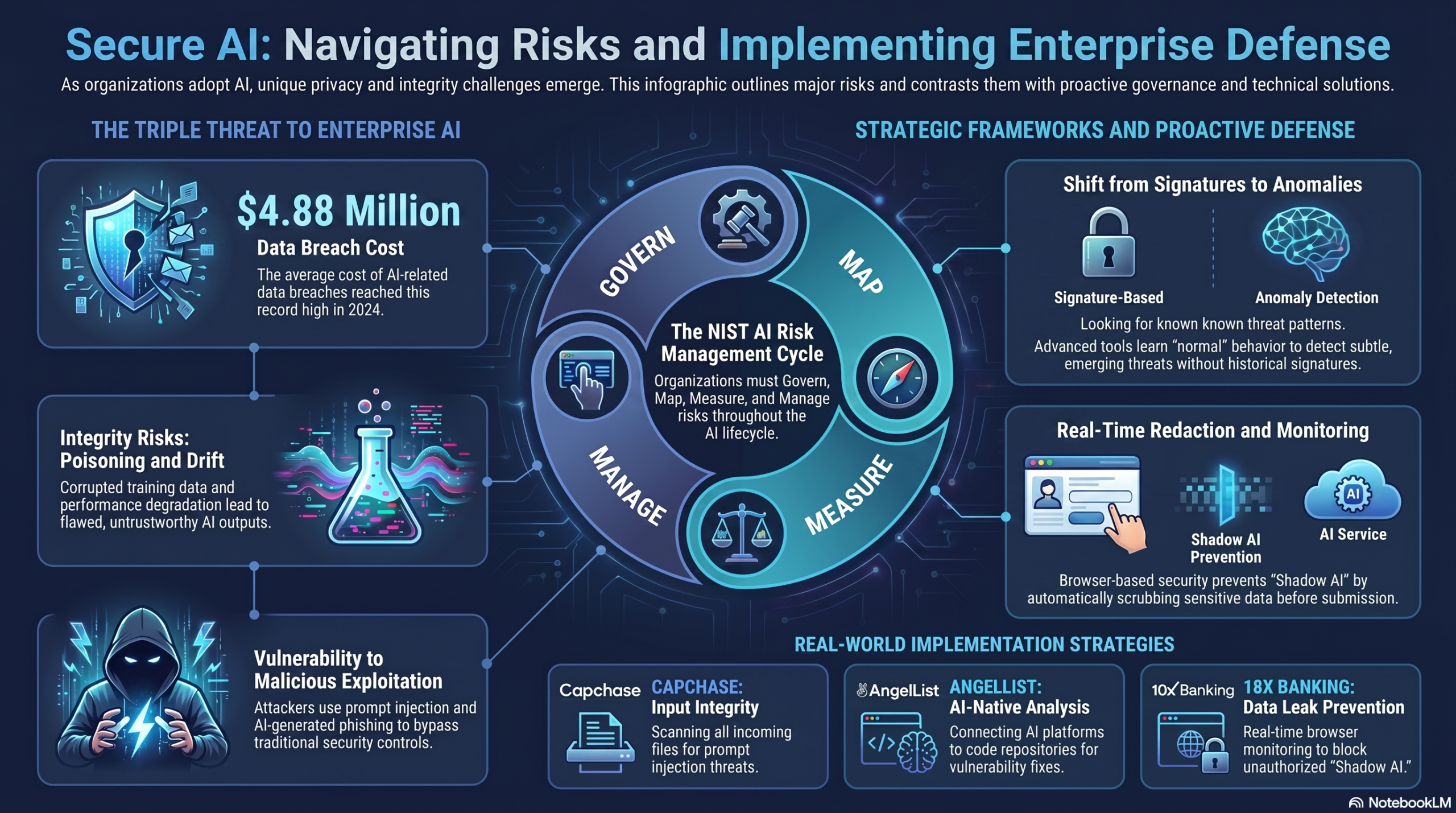
AI systems can expose sensitive data through model leakage or by processing confidential datasets without proper access controls. When AI models are trained on proprietary information, the outputs may unintentionally reveal sensitive data. These breaches carry significant financial consequences, with the average cost of AI data breaches reaching $4.88 million in 2024. Organizations need strict data handling protocols to protect sensitive information from exposure through AI systems.
Challenges to Model Integrity and Accuracy
Training data poisoning allows malicious actors to introduce corrupted information into the datasets used to train AI models. Another challenge is model drift, where an AI system’s performance gradually degrades as real-world conditions change beyond the original training data. These issues lead to flawed outputs that erode trust in the AI system, causing employees to question the reliability of AI-generated insights.
The Dangers of Malicious Use
Bad actors can exploit AI systems through prompt injection attacks, which involve manipulating the instructions given to an AI system to make it behave in unintended ways. Attackers can also leverage AI to create social engineering attacks that generate convincing phishing emails or realistic deepfake content. These threats develop rapidly as attackers discover new vulnerabilities in AI implementations.
Foundational Frameworks for AI Risk Management
Government and industry bodies have developed frameworks that provide a starting point for organizations building AI security programs. The NIST AI Risk Management Framework offers a structured method for identifying and reducing AI-related risks at every stage of development and deployment. Its four core functions help organizations govern AI systems through clear accountability structures, map potential risks within their specific context, measure the effectiveness of existing controls and manage identified risks with appropriate mitigation strategies.
The U.S. Department of Homeland Security has also developed safety and security guidelines for critical infrastructure owners and operators. These emphasize secure-by-design AI implementation with mandatory human oversight of AI systems to help organizations reduce operational risks in sectors where failures could impact public safety.
How Businesses Are Securing AI Initiatives
Theory and frameworks are important, but seeing how real companies tackle these challenges provides practical insight. The following case studies demonstrate different approaches in action.
Darktrace’s Proactive AI Security Posture
While frameworks provide important structure, organizations also need active security tools designed specifically for AI threats. Darktrace addresses these concerns through an approach that differs fundamentally from traditional security. As an early adopter of AI, Darktrace’s solutions are more advanced than competitors’ and integrate easily with existing infrastructure, often in a single click from its customer portal.
Darktrace’s core multi-layered AI looks for anomalous events rather than relying on predefined threat signatures. This is one of the best approaches for securing enterprise AI, reducing the chances of false positives when compared to static, historical-based tools that look for threats based on previous attack patterns. Instead of assuming what a threat looks like in advance, the system learns normal behavior for every device and user, allowing it to spot subtle anomalies that indicate an emerging threat.
Capchase’s Approach to AI Security
Capchase, a fintech platform, faced security vulnerabilities while integrating AI into its operations. The company was particularly concerned about prompt injection attacks from user-uploaded documents that could compromise sensitive financial data.
They implemented Superagent as a security layer to scan all incoming files for threats before they reached the AI system. To ensure universal adoption, they created a rule that prevented developers from using insecure methods. By embedding security directly into their architecture, Capchase made it impossible to ship insecure code by default. This approach protects them from known threats and future vulnerabilities without slowing their development pace.
AngelList’s AI-Native Security Program
AngelList’s security team aimed to build an AI-powered security program but found that using general large language models for code scanning was unreliable. The probabilistic nature of the models produced inconsistent results, making it difficult to establish a stable security process.
The team adopted depthfirst’s General Security Intelligence, an AI-native platform designed specifically for security analysis. The platform connected to their code repositories to understand their business logic, consistently identifying real vulnerabilities with specific code suggestions for fixes within pull requests. AngelList uncovered complex vulnerabilities faster than previous methods and more than doubled the security team’s efficiency.
10x Banking’s Strategy for Secure AI
The 10x Banking security team needed to control how employees used AI tools to prevent leaking sensitive data without blocking innovation across the organization. A particular concern was shadow AI, where employees use unauthorized AI tools that operate outside the security team’s visibility.
They implemented Prompt Security through a browser extension that monitors AI interactions in real time. The system automatically redacts sensitive data before submission to any AI tool while discovering which AI applications employees actually use. This allowed 10x Banking to shift from restricting AI to safely enabling it, confidently supporting more AI applications while maintaining strong data protection.
Building a Resilient and Future-Ready AI Security Strategy
A strong AI security approach involves understanding the specific risks facing the organization and applying frameworks alongside proactive detection tools. Organizations that combine structured governance with advanced anomaly detection capabilities can secure their AI initiatives without sacrificing innovation. As AI technology progresses, security strategies must adapt to address emerging threats.

As the Features Editor at ReHack, Zac Amos writes about cybersecurity, artificial intelligence, and other tech topics. He is a frequent contributor to Brilliance Security Magazine.
Additional Resource
Video Overview
Follow Brilliance Security Magazine on LinkedIn to ensure you receive alerts for the most up-to-date security and cybersecurity news and information. BSM is cited as one of Feedspot’s top 10 cybersecurity magazines.