

Industrial environments increasingly connect information technology (IT) and operational technology (OT), expanding the attack surface of industrial control systems (ICS). ICS are high-value targets because they manage critical physical processes in energy, manufacturing and utilities. Limited patching, legacy technology and prioritizing availability over security increase exposure, making them attractive to attackers seeking operational disruption and systemic impact.
IT-side breaches can now pivot into OT networks, enabling attackers to compromise ICS environments without direct access to industrial infrastructure or plant systems.
The IT-to-OT Attack Pathway
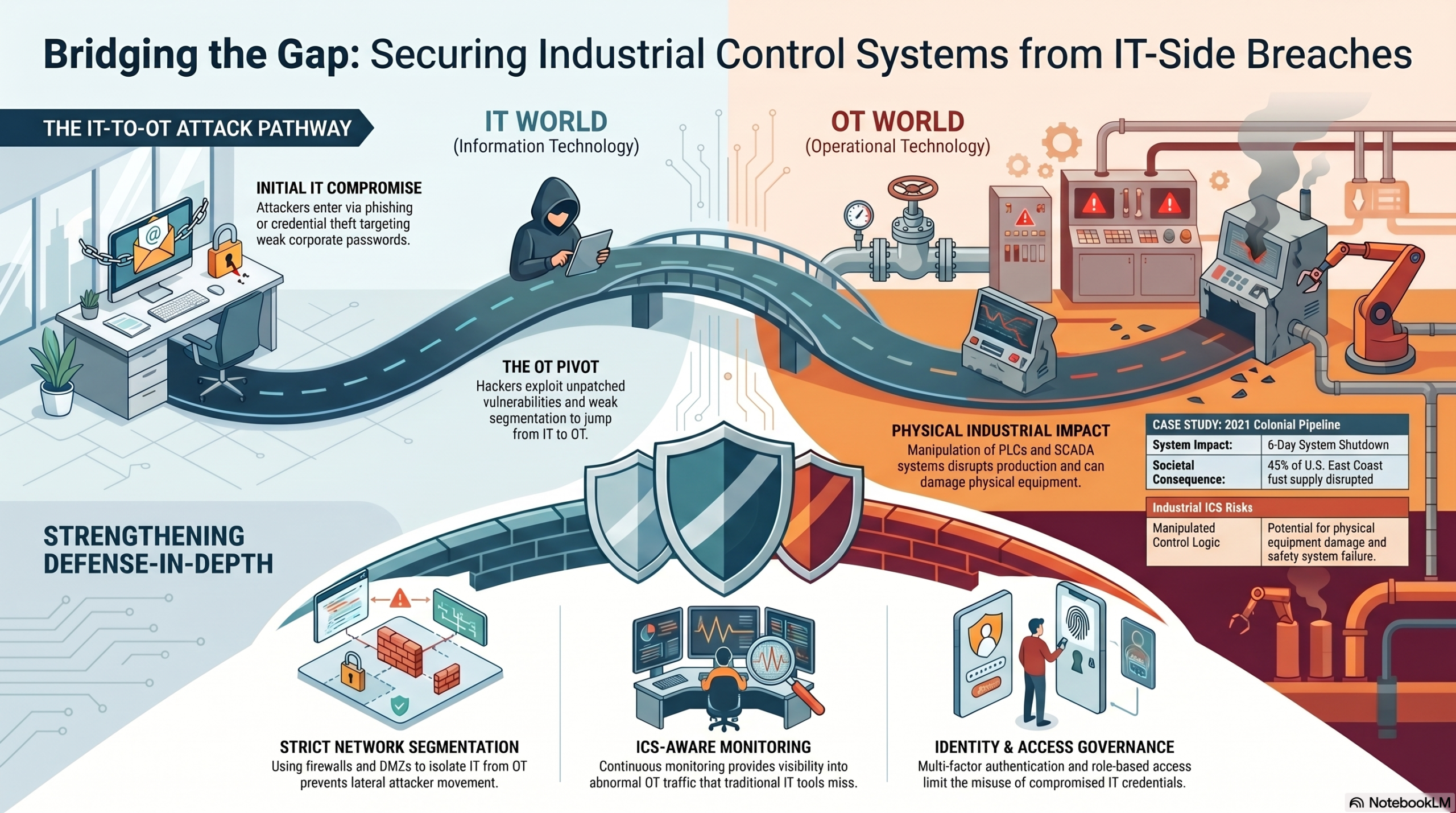
Modern industrial networks are typically segmented into IT and OT systems. However, this segmentation is often imperfect in practice. Shared authentication systems, legacy integrations, remote access tools and insufficient monitoring can create exploitable pathways. A typical IT-to-OT attack chain may unfold as follows:
- Initial compromise of IT systems: Attackers enter IT environments via phishing, credential theft from weak or reused passwords, or malware from malicious downloads and attachments.
- Lateral movement within the IT environment: They move across IT networks by exploiting unpatched vulnerabilities, escalating privileges, and identifying trusted connections and key assets.
- Pivot into OT networks: From IT control, attackers exploit weak segmentation, misuse virtual private networks, and compromise engineering workstations or data historians linking IT and OT.
- Impact on ICS: Attackers manipulate programmable logic controllers and supervisory control and data acquisition systems, disrupt operations, and corrupt data, affecting industrial processes.
Common IT-Side Vulnerabilities That Expose Industrial Control Systems
Several weaknesses in IT networks serve as entry points for attackers aiming to reach ICS environments.
Initial Access and Exploitation
Phishing allows attackers to gain valid access to corporate systems, while unpatched software and legacy systems provide exploitable vulnerabilities that enable deeper compromise.
Lateral Movement and Escalation
Once inside, attackers exploit weak internal controls to escalate privileges and move across networks, identifying systems connected to operational environments.
IT-OT Bridging Weaknesses
Poor network segmentation, third-party connections and remote access tools create pathways between IT and OT networks. If compromised, these links can provide direct access to ICS
The Consequences of Industrial Control Systems Compromise
ICS compromise can result in severe operational, physical and financial disruption. Attackers may halt production, damage equipment through manipulated control logic, compromise safety systems and introduce data corruption that affects industrial decision-making. In critical infrastructure sectors, these impacts can extend beyond individual organizations and disrupt essential services at a regional or national level.
A clear example is the 2021 Colonial Pipeline ransomware incident, which forced the shutdown of a system responsible for supplying 45% of fuel to the U.S. East Coast for six days. The disruption led to fuel shortages and operational instability, demonstrating how IT-originated attacks can quickly cascade into large-scale industrial and societal impact when they reach critical systems.
Strengthening Defense-in-Depth for Industrial Control Systems Protection
A layered approach is required to reduce IT-to-OT attack risks.
Network Segmentation and Isolation
Strong segmentation between IT and OT limits lateral movement. Firewalls, zoning and controlled DMZ data exchange help prevent attackers from reaching industrial systems.
Intrusion Detection and Monitoring
ICS-aware intrusion detection improves visibility into abnormal OT traffic. Continuous monitoring and real-time alerts help detect threats that traditional IT tools miss.
Identity and Access Management
Strong access controls reduce misuse of compromised credentials. Multi-factor authentication and role-based access limit privilege escalation across IT and OT systems.
Security Assessments and Testing
Regular testing identifies weaknesses before attackers do. Penetration tests and red-team exercises validate segmentation and remote-access security. Organizations that claim compliance while failing to address critical IT-to-OT vulnerabilities face significant legal risk.
The Role of Upgraded Systems and Modern Technology
Centralized, real-time systems like enterprise resource planning demonstrate how unified data improves visibility and speeds decision-making across complex environments, including ICS. Similar modernization in industrial settings strengthens security by improving coordination between IT and OT.
Upgrading legacy ICS infrastructure reduces exposure by adding encryption, secure authentication and better patching. Modern platforms also improve monitoring and detection through centralized telemetry and secure-by-design architectures, helping organizations identify threats faster and limit the escalation of IT-to-OT attacks.
Building a Resilient Security Posture
Protecting ICS from IT-side breaches requires a shift in mindset. Security cannot be treated as separate silos for IT and OT. Instead, it must be approached as a unified risk environment. A resilient strategy includes:
- Continuous monitoring with industrial-aware detection tools
- Strict identity and access governance
- Regular testing and validation of security controls
- Thoughtful modernization of legacy systems
A resilient strategy should also include strong segmentation between IT and OT networks. This separation helps prevent attackers from moving from a compromised IT system into the industrial environment. Containing breaches protects critical physical processes from disruption.
Securing the IT to OT Boundary
Securing industrial environments requires treating IT networks as potential entry points into ICS. Through segmentation, continuous monitoring, strong access controls and modernized systems, organizations can limit attacker movement and prevent IT-side breaches from escalating into disruptive ICS compromises.

Devin Partida is a frequent contributor to Brilliance Security Magazine, an industrial tech writer, and the Editor-in-Chief of ReHack.com, a digital magazine for all things technology, big data, cryptocurrency, and more. To read more from Devin, please check out the site.
Additional Resources
Video Overview
Follow Brilliance Security Magazine on LinkedIn to ensure you receive alerts for the most up-to-date security and cybersecurity news and information. BSM is listed among Feedspot’s top 10 cybersecurity magazines.