

In Episode S8E3 of the Brilliance Security Magazine Podcast, host Steven Bowcut sits down with Hiram E. Chodosh, President of Claremont McKenna College (CMC), to explore what cybersecurity leadership looks like in higher education—an environment that is open by design, highly collaborative, and constantly changing. Their conversation examines how a university leader frames cybersecurity as a matter of governance and enterprise risk, how institutions balance academic freedom with meaningful security controls, and how AI is reshaping both the threat landscape and the classroom.
Summary
President Chodosh brings a top-level leadership perspective to a challenge many cybersecurity professionals underestimate: universities aren’t simply smaller versions of enterprises. They are complex ecosystems built around openness, experimentation, decentralized decision-making, and high rates of user turnover—conditions that create a unique and often unforgiving security posture.
A major theme of the discussion is how cybersecurity must be understood at the presidential level—not as a narrow IT function, but as a mission-critical responsibility tied to institutional resilience, continuity, trust, and risk governance. President Chodosh discusses how leaders evaluate tradeoffs, set expectations, and communicate security priorities in a culture that must protect learning, research, and community life while remaining open enough to fulfill its academic mission.
The conversation also explores:
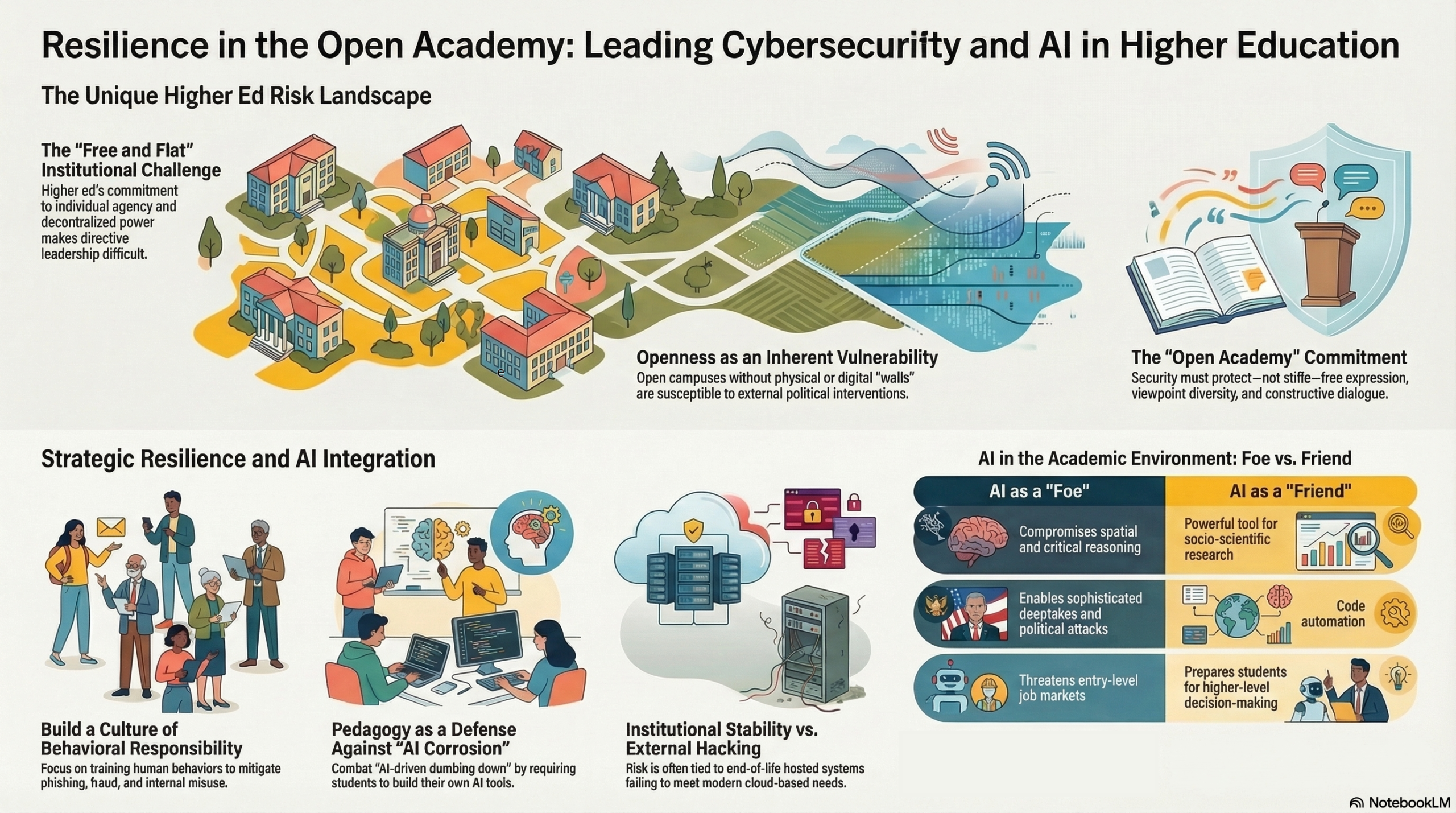
- The unique cybersecurity challenges facing higher education: Listeners will learn how colleges must balance necessary security controls with their core commitments to academic freedom, open access, and a highly decentralized, collaborative structure.
- How navigating past crises builds institutional resilience: The episode explains how successfully managing major disruptions, such as virtualizing curricula during the COVID-19 pandemic, builds the agility and inner confidence needed to handle unpredictable cyber threats.
- The connection between community safety and digital security: Through an anecdote about campus safety staff rescuing a professor’s belongings during a flood, listeners will understand how building a culture of attentiveness and “surround sound” support translates directly to how an institution handles cybersecurity incidents.
- The crucial role of behavioral training: Listeners will discover that combating human vulnerabilities—such as the tendency to fall for phishing or fraud—through strong behavioral training and auditing is foundational to protecting an institution.
- The dual nature of AI as both a “friend and foe”: The discussion explores the risks of AI acting as an addictive expedient that could compromise independent human intelligence and spatial reasoning, alongside its immense potential as a tool.
- How to integrate AI and computation into foundational learning: The show details a revolutionary integrated science program where all students are required to learn Python, build their own AI-generative systems, and conduct original socio-scientific research.
- The importance of securing core operational infrastructure: Listeners will learn that protecting aging hosted systems and adapting to cloud-based student information systems is critical, as the failure of these systems can completely halt a university’s ability to operate.
- The rising risk of politically motivated cyber attacks: The episode highlights how the inherent openness of college campuses makes them prime targets for culture wars and political attacks, which can be exacerbated by the malicious use of AI-generated content.
- Best practices for CISOs communicating with institutional leadership: Security professionals will gain advice on how to better communicate with college presidents and boards by translating technical risks into lay terms, cross-leveraging academic expertise, and maintaining an even temperament rather than relying on catastrophic thinking.
- The value of unconditional cyber support for students: Listeners will learn about a leadership ethos that extends security support to students’ personal digital lives, treating individual issues like a hacked account or a stolen device as an attack on the community that requires immediate, full support.
Throughout the episode, President Chodosh connects strategy with real leadership decision-making—how to think about cyber risk when the institution’s mission requires openness, how to keep pace with rapid technological change, and what resilient governance looks like when AI is transforming both threats and education.
About our Guest

Hiram E. Chodosh is the President of Claremont McKenna College, one of the nation’s leading liberal arts colleges. His career spans law, international legal reform, and higher education leadership. He is widely recognized for advancing institutional innovation and academic excellence, as well as for leadership in initiatives supporting freedom of expression and constructive dialogue in higher education.
Click the image below to listen to this Brilliance Security Magazine Podcast episode.

Additional Resources
Video Overview
Infographic

Steven Bowcut is the Editor-in-Chief of Brilliance Security Magazine and host of the BSM Podcast. He has spent years covering cybersecurity and physical security, focusing on the technologies, strategies, and leadership insights that matter most to security practitioners and decision-makers. Through the magazine and podcast, Steven brings readers and listeners practical content with industry leaders, innovators, and experts shaping the future of security. Follow and connect with Steve on Instagram and LinkedIn.