How Iru is simplifying modern security by converging identity, endpoint management, compliance, and AI-driven context
In Episode S8E5 of the Brilliance Security Magazine Podcast, host Steven Bowcut sits down with Satyam Patel, CISO and CIO at Iru, to discuss what it takes to simplify security operations in an environment where identity, endpoint management, compliance, and AI are increasingly intertwined. Drawing on more than 25 years of cybersecurity and IT leadership experience, Patel explains how his dual leadership role shapes his perspective on security, operational efficiency, and business alignment. The conversation also explores Iru’s approach to collapsing fragmented tool stacks into a unified platform spanning identity, endpoint, compliance, and AI-driven context.
Summary
Satyam Patel begins the conversation by reflecting on the experiences that shaped his leadership philosophy over more than two decades in cybersecurity. He explains that strong security leadership is about more than defending against threats. In his view, effective leaders must align security initiatives with broader business priorities, collaborate closely with executive stakeholders, and build programs that emphasize resilience, awareness, and continuous improvement.
The discussion then turns to Patel’s dual role as both CISO and CIO at Iru. He explains that holding both positions gives him a broader perspective on how security decisions affect not only risk posture, but also usability, employee experience, and operational efficiency. Rather than approaching security as a function focused solely on control and enforcement, Patel describes a model in which security must support business outcomes and help reduce friction across the organization.
Bowcut and Patel next introduce Iru for listeners who may not yet be familiar with the company. Patel describes Iru as a unified platform built to secure users, applications, and devices while helping organizations remain audit-ready. The conversation explores the company’s focus on identity, endpoint management, compliance, and AI-driven context, and how that combination reflects the changing needs of modern IT and security teams.
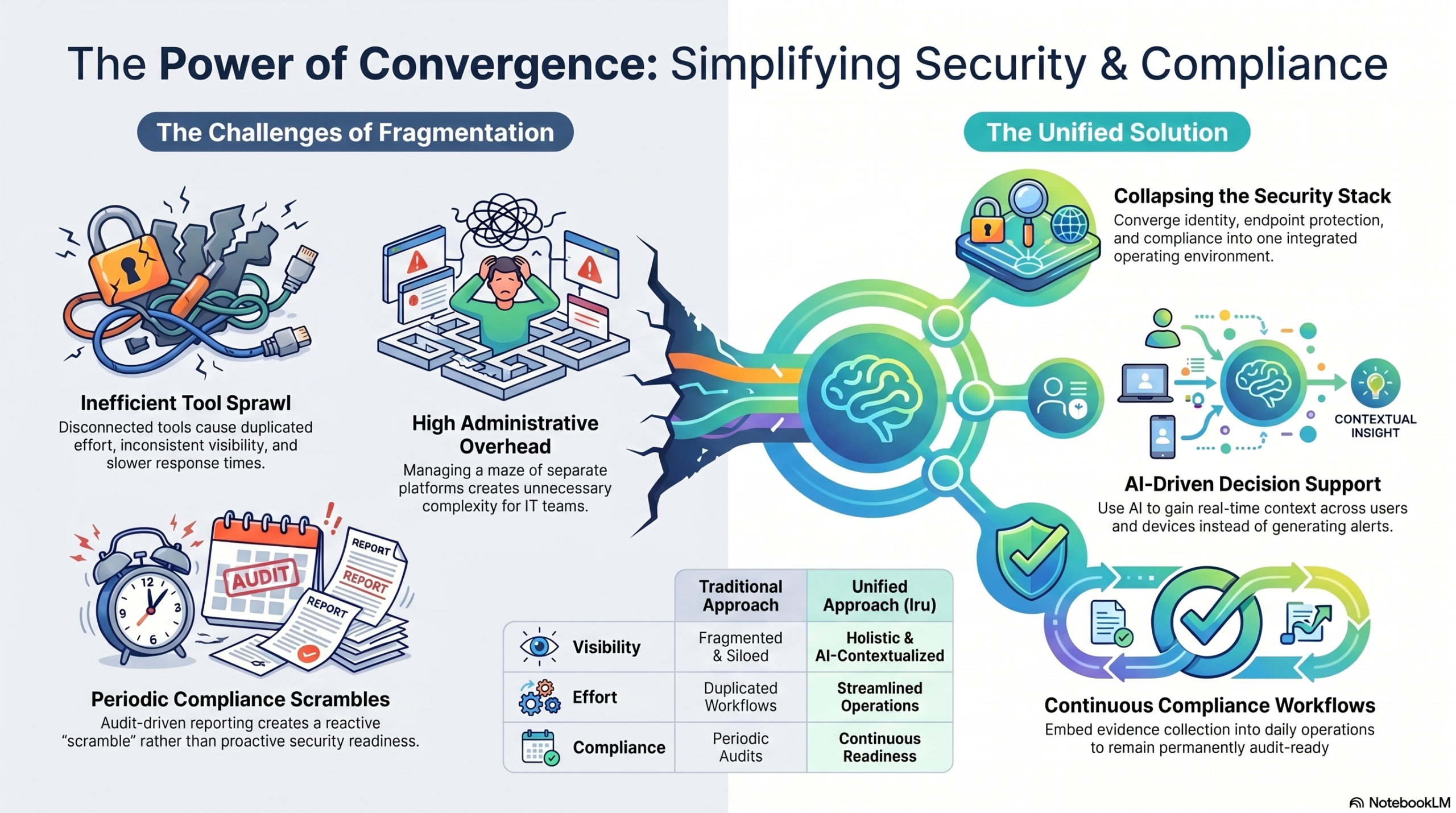
A major theme of the episode is the growing need for convergence. Patel explains that many organizations still manage identity, endpoints, and compliance through disconnected tools and separate teams, which often results in duplicated effort, inconsistent visibility, slower response times, and unnecessary administrative overhead. He discusses Iru’s approach to “collapsing the stack” and why simplifying fragmented security and IT environments has become a strategic priority for organizations trying to improve both security outcomes and operational efficiency.
The conversation also examines Iru’s emphasis on context and AI. Patel explains that AI is most valuable when it helps teams make better decisions across users, applications, and devices rather than simply producing more alerts or adding another layer of complexity. This leads to a broader discussion about how organizations should think about AI in security: not as a marketing feature, but as a way to reduce friction, improve visibility, and make more informed decisions in real time.
Patel also discusses what differentiates Iru from more traditional point-solution approaches. Rather than treating identity, endpoint protection, compliance automation, and related capabilities as separate categories, he describes the value of bringing them together into a single operating environment. That integrated view, he explains, can help organizations secure access, protect devices, demonstrate compliance, and improve the overall user experience without forcing teams to manage a maze of disconnected platforms.
Compliance is another important focus of the episode. Patel argues that compliance should no longer be treated as a periodic, audit-driven scramble. Instead, he makes the case for a more operational and continuous approach, one in which evidence collection, readiness, and security practices are embedded into everyday workflows. This part of the discussion highlights how organizations can make compliance more useful to both security teams and the business as a whole.
The episode closes with practical takeaways for security and IT leaders. Patel offers advice on reducing tool sprawl, improving alignment between identity and endpoint strategies, and treating compliance as an ongoing discipline rather than a separate reporting exercise. He also shares his perspective on the mindset leaders will need in the years ahead if they want to remain resilient, efficient, and prepared for a security landscape increasingly shaped by AI.
About our Guest

Satyam Patel is the CISO and CIO at Iru and a results-driven senior security advisor with more than 25 years of experience protecting organizations from cyber threats. He is known for developing comprehensive security strategies, leading high-performing teams, and aligning security initiatives with business goals through close collaboration with executive leadership and cross-functional stakeholders.
A Certified Chief Information Security Officer through EC-Council, Patel is a recognized thought leader who champions security awareness, compliance, and continuous improvement. His technical expertise includes application security, cloud security, identity access management, patch management, and related security disciplines.
Click the image below to listen to this episode of the Brilliance Security Magazine Podcast.


Steven Bowcut is the Editor-in-Chief of Brilliance Security Magazine and host of the BSM Podcast. He has spent years covering cybersecurity and physical security, focusing on the technologies, strategies, and leadership insights that matter most to security practitioners and decision-makers. Through the magazine and podcast, Steven brings readers and listeners practical content with industry leaders, innovators, and experts shaping the future of security. Follow and connect with Steve on Instagram and LinkedIn.
Additional Resources
Video Overview
Infographic