

A penetration test can expose weaknesses in an organization’s defenses. Its value also depends on what happens afterward. Can the team understand the findings, fix the exposure, and demonstrate that the changes worked?
In Episode S8E13 of the Brilliance Security Magazine Podcast, host Steven Bowcut talks with Darin Fredde, Senior Director of Technical Marketing Engineering and Offensive Security Evangelist at Ridge Security, about making that process more effective with AI. Drawing on his experience in enterprise security architecture, penetration testing, and cybersecurity education, Fredde explains how organizations can test more frequently while maintaining control over sensitive information and testing boundaries.
Episode Summary
Fredde begins with his unconventional journey into cybersecurity, from trade school and computer-aided design to technology leadership and enterprise offensive security. Those experiences shaped his interest in the gap between how secure an organization believes it is and what testing can demonstrate. For Fredde, a good assessment gives the people responsible for building and operating systems evidence they can use to improve them.
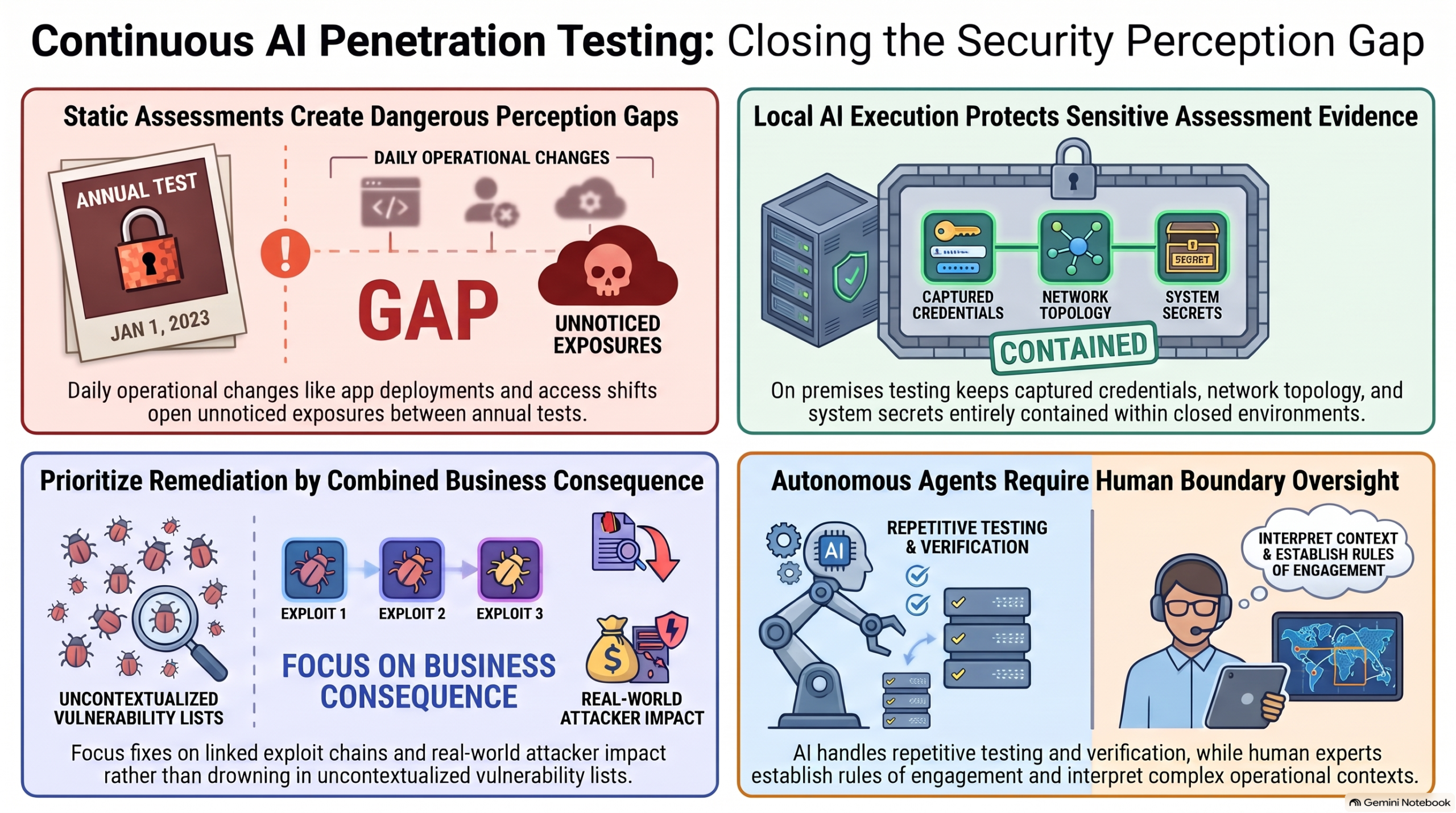
That evidence needs to keep pace with ordinary business changes. New applications, additional service-account permissions, and connections between systems can alter an organization’s exposure between scheduled assessments. Fredde explains why more frequent testing helps teams examine those relationships and verify that remediation has closed the original weakness.
The conversation introduces RidgeOne, an appliance that combines Ridge Security’s RidgeGen platform with an AI model running locally. Fredde describes how the model supports reasoning while the platform executes testing, applies controls, and captures evidence. For organizations with sensitive or restricted environments, local processing can make AI-assisted assessments easier to approve and deploy.
Keeping the model on premises is one part of protecting assessment data. Fredde recounts a school district engagement in which a penetration-test report reached a student who used it as a roadmap. He encourages security teams to examine how credentials, logs, reports, backups, and support processes handle sensitive information. He also describes Ridge Security’s SafeBox approach to keeping credentials outside the model’s readable context.
A practical remediation example shows why connected findings deserve attention. Exposed credentials may lead to excessive permissions and access to sensitive data. Fredde walks through addressing the immediate access, rotating credentials, reviewing sessions and tokens, reducing permissions, correcting the application’s handling of secrets, and verifying the results.
Human judgment remains central throughout the process. Fredde explains what evidence should support an AI-generated finding and when application owners or human testers should review the conclusions. He also discusses setting rules of engagement, enforcing boundaries outside the model’s discretion, and maintaining a clear record of what was authorized and what occurred.
The episode closes with guidance for evaluating a pilot and its costs. Alongside hardware, licensing, maintenance, and staff time, Fredde would measure assessment coverage, independently validated findings, remediation verification time, analyst effort, and operational impact. He would also involve defenders to determine whether they detected the testing activity and improved their response. His measure of success is direct—show what the team fixed, how it proved the fix, and whether it can repeat the process.
Listen to the Podcast
Click the image below to listen to Episode S8E13 of the Brilliance Security Magazine Podcast.

About Our Guest

Darin Fredde is the Senior Director of Technical Marketing Engineering and an Offensive Security Leader at Ridge Security. He brings more than two decades of experience across technology and cybersecurity, including roles in technology leadership, enterprise security architecture, hands-on penetration testing, and offensive security program development.
At U.S. Bank, Fredde helped lead the evolution of the enterprise penetration-testing capability, ultimately taking responsibility for the penetration-testing product and its transformation. His consulting experience includes work with local and state governments, police departments, schools, and commercial organizations.
Fredde holds a master’s degree in cybersecurity from the University of Dallas and is a Certified Information Systems Security Professional. He also teaches cybersecurity and ethical hacking at Dallas College.
Additional Resources
Video Explainer
Infographic

Steven Bowcut is the Editor-in-Chief of Brilliance Security Magazine and host of the BSM Podcast. He covers cybersecurity and physical security, focusing on the technologies, strategies, and leadership decisions that matter to security practitioners and decision-makers. Through the magazine and podcast, Steven brings readers and listeners practical insights from industry leaders, innovators, and experts.