
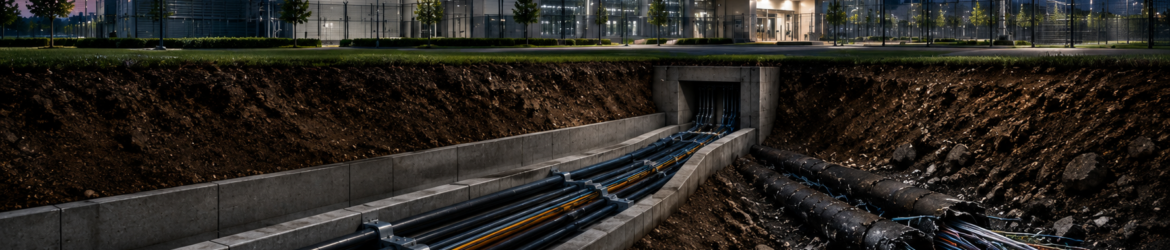
Enterprise security strategies prioritize digital defenses while overlooking the physical infrastructure that carries power and data. Exposed network cables are subject to environmental stress and deliberate sabotage, which can undermine even sophisticated cybersecurity measures.
Cable infrastructure hardening addresses this vulnerability. Organizations seeking resilient operations can acquire protective sleeving from an experienced expandable sleeving manufacturer. This way, they can implement strategic pathway design and create a foundation for business continuity and operational reliability.
The Focus on Physical Layer Security
Without secure cables and power distribution systems, software-based protections can become irrelevant. Fiber-optic cables and power infrastructure create the foundation for every digital transaction and communication.
In fact, fiber-optic cables represent one driver behind the increasing linear mileage of buried utility and service lines, which now comprises around 50 million miles in total length in the U.S. Despite this footprint, the physical layer has been a blind spot in many cybersecurity strategies. Protective solutions like high-quality braided sleeving help address these physical vulnerabilities.
Recognizing Physical Infrastructure Vulnerabilities
Physical cable networks face various risks, including coordinated attacks. Understanding these vulnerabilities helps organizations prioritize appropriate protective measures.
From Accidental Damage to Deliberate Sabotage
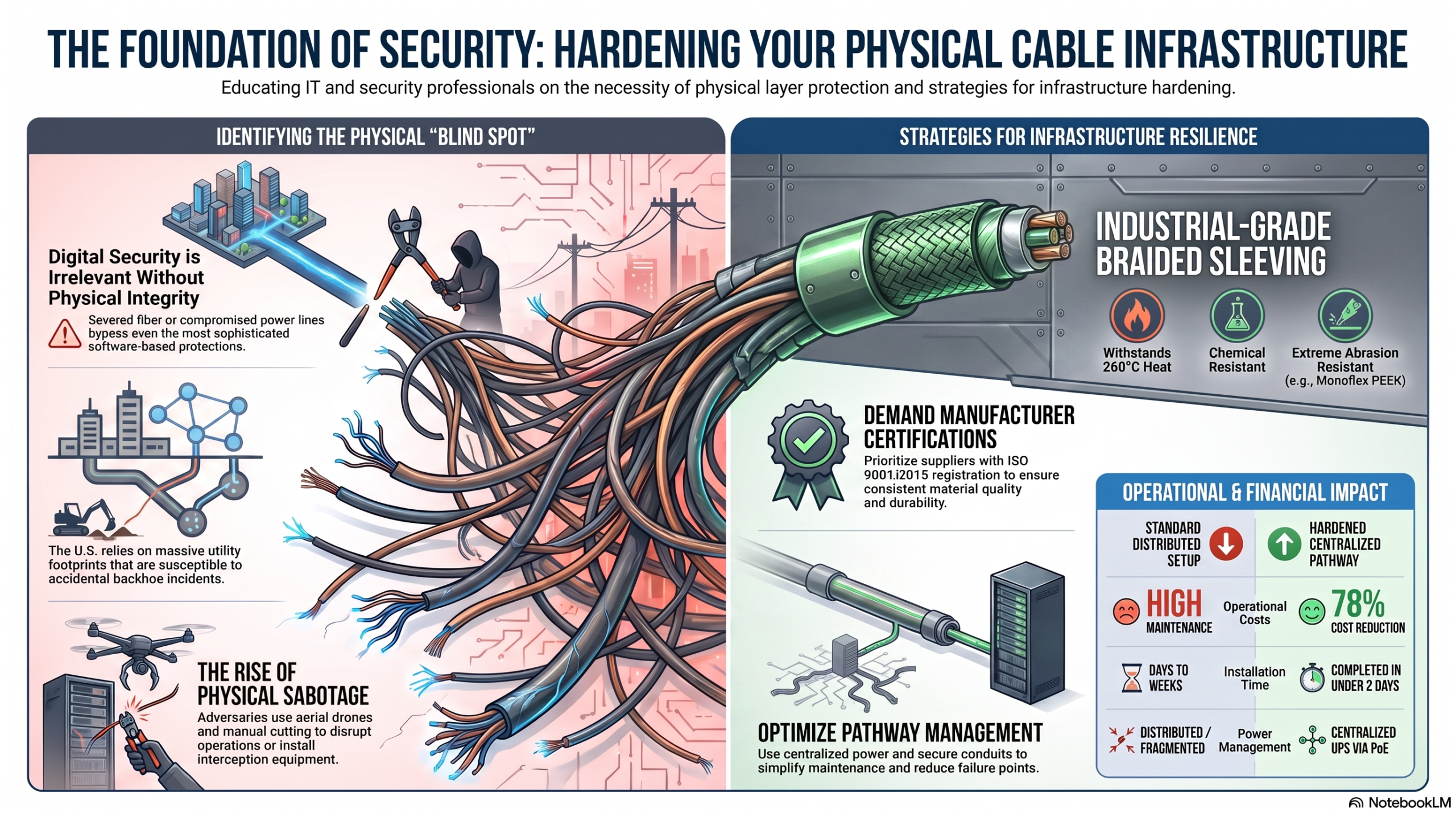
Construction accidents and environmental wear represent common threats to cable integrity. A single backhoe incident can sever fiber connections serving thousands of users, while temperature extremes and chemical exposure gradually compromise unprotected cables.
Intentional sabotage poses more severe threats as adversaries target physical infrastructure to disrupt communications and operations. For example, physical cutting of submarine or terrestrial fiber cables can be a tool of state-sponsored disruption. Aerial drones can threaten aboveground cable infrastructure in ways that traditional security measures fail to address.
The Costs of Network Downtime and Data Breaches
Physical infrastructure failures have consequences beyond repair costs. Operations halt due to severed connections, creating economic disruption. Then, public trust erodes when service availability cannot be maintained.
Compromised physical infrastructure enables unauthorized interception or access to devices. Attackers with physical access to network cables can install monitoring equipment or inject malicious traffic.
Resilient cable infrastructure, designed to withstand accidental failures and deliberate attacks, protects operational continuity and sensitive information. Partnering with a qualified expandable sleeving manufacturer solves these physical vulnerabilities.
Strategies for Hardening Your Cable Infrastructure
Transitioning from vulnerability recognition to protection requires proven technologies and design. Careful material selection and strategic pathway management improve infrastructure resilience.
Select Protective Materials for High-Stress Environments
Industrial cable hardening relies on advances in materials science. Extreme temperatures, abrasion from moving equipment, chemical exposure and moisture infiltration create demanding conditions that require high-performance protective sleeving.
Atkins & Pearce’s high-quality braided sleeving is designed to protect cables against abrasion, heat, chemicals and mechanical wear. The Monoflex PEEK demonstrates this capability by offering protection that withstands temperatures up to 260° Celsius, enabling it to withstand multiple sterilization cycles.
This combination of advanced material engineering and consistent manufacturing processes strengthens infrastructure reliability. It also maintains flexibility during installation and maintenance, supported by the company’s ISO 9001:2015 registration.
Implement Secure Cable Pathways and Management
Protection extends beyond cables to encompass pathway infrastructure. Conduits, trays and secure enclosures form foundational elements of physical security through organized, structured cabling.
Panduit connected its Class 4 Transmitter Chassis to a centralized uninterruptible power supply (UPS), which activated distributed Power over Ethernet switches across several 86,000 square-foot buildings.
This solution eliminated hard-to-manage distributed UPSs at each remote location, located 100 to 1,000 feet from the centralized transmitters. The Miller Electric Company estimated a 78% reduction in yearly operational costs due to the limited number of UPS systems requiring maintenance.
“By far this was the easiest electrical install we have done so far,” says Chris Cuyler, Miller Electric’s Sr. Project Manager of Integrated Solutions. “What would have taken several days to weeks… was done with one single shutdown for two hours, and completed in just under two days.” These results demonstrate how structured infrastructure and disciplined manufacturing practices improve long-term reliability.
What Should You Look for When Choosing a Braided Sleeving Supplier?
IT and security professionals should consider specific criteria that indicate manufacturing quality and technical capability.
Manufacturing Standards and Certifications
Quality standards like ISO certifications provide evidence of consistent processes and product performance. Evaluating long-term durability through quality assurance processes proves more valuable than relying solely on product specifications.
Requesting technical documentation allows buyers to assess test material certifications and performance data. Direct sourcing from an expandable sleeving manufacturer, rather than a distributor, also provides better access to detailed technical information and engineering support.
Techflex is another useful benchmark when comparing sleeving suppliers. The company manufactures braided sleeving, and its ISO 9001:2015 quality system gives specifiers another point of comparison for process control.
Its Battle Braid line also shows how material selection changes by risk profile, offering cut-, impact- and abrasion-resistant polyester sleeving for vehicle, industrial and military environments.
Customization Capabilities and Direct Support
Custom solutions and direct technical support enable tailored approaches for unique conditions. This capability becomes particularly valuable when standard products do not meet specific temperature ranges or chemical resistance requirements.
Belden worked with UBS Arena using its REVConnect 10GXW Category 6A cabling to harden the Wi-Fi and mobile coverage against signal degradation while supporting multi-gigabit speeds. It used a standardized and easy-to-learn termination system that hardened the physical infrastructure against common installation errors and faulty connections across over 6,700 cables.
This shows that access to high-quality braided sleeving with customization options optimizes protection for specific operational requirements. Belden’s manufacturing plants are primarily certified to ISO 9001, with several facilities also certified to ISO 14001, providing assurance of the company’s quality and environmental management practices.
Frequently Asked Questions
Here are common considerations when planning infrastructure protection strategies.
What is the main difference between industrial and commercial-grade cabling?
Industrial-grade cabling provides enhanced environmental resistance and mechanical protection compared to commercial alternatives. It tolerates higher temperatures and handles greater physical stress. Commercial cabling typically operates in controlled environments with minimal exposure to harsh conditions.
How does cable hardening help protect against electromagnetic interference (EMI)?
Braided sleeving, proper grounding and strategic routing work together to reduce EMI exposure. Braided metallic sleeving provides electromagnetic shielding while maintaining flexibility. Proper routing keeps cables away from EMI sources like motors and transformers. These measures preserve signal integrity in electrically noisy environments.
Building a Resilient Foundation for Your Network’s Future
Physical layer security is a pillar of cybersecurity. Quality protective materials and trusted suppliers help enterprises handle failures and attacks. Growing infrastructure dependencies make proactive investment in cable hardening essential. An experienced expandable sleeving manufacturer builds the physical foundation that digital operations require.

Emily Newton is the Editor-in-Chief at Revolutionized Magazine. A regular contributor to Brilliance Security Magazine, she has over four years of experience writing articles in the industrial sector.
Additional Resource
Video Overview
Follow Brilliance Security Magazine on LinkedIn to ensure you receive alerts for the most up-to-date security and cybersecurity news and information. BSM is cited as one of Feedspot’s top 10 cybersecurity magazines.