

In Episode S8E9 of the Brilliance Security Magazine Podcast, host Steven Bowcut welcomes back Alex Brennan, Vice President of Global Enterprise Sales at Sign In App, for a conversation about the transformation of visitor management from a front-desk function into a strategic security and risk-management capability.
Summary
Beyond the Digital Logbook
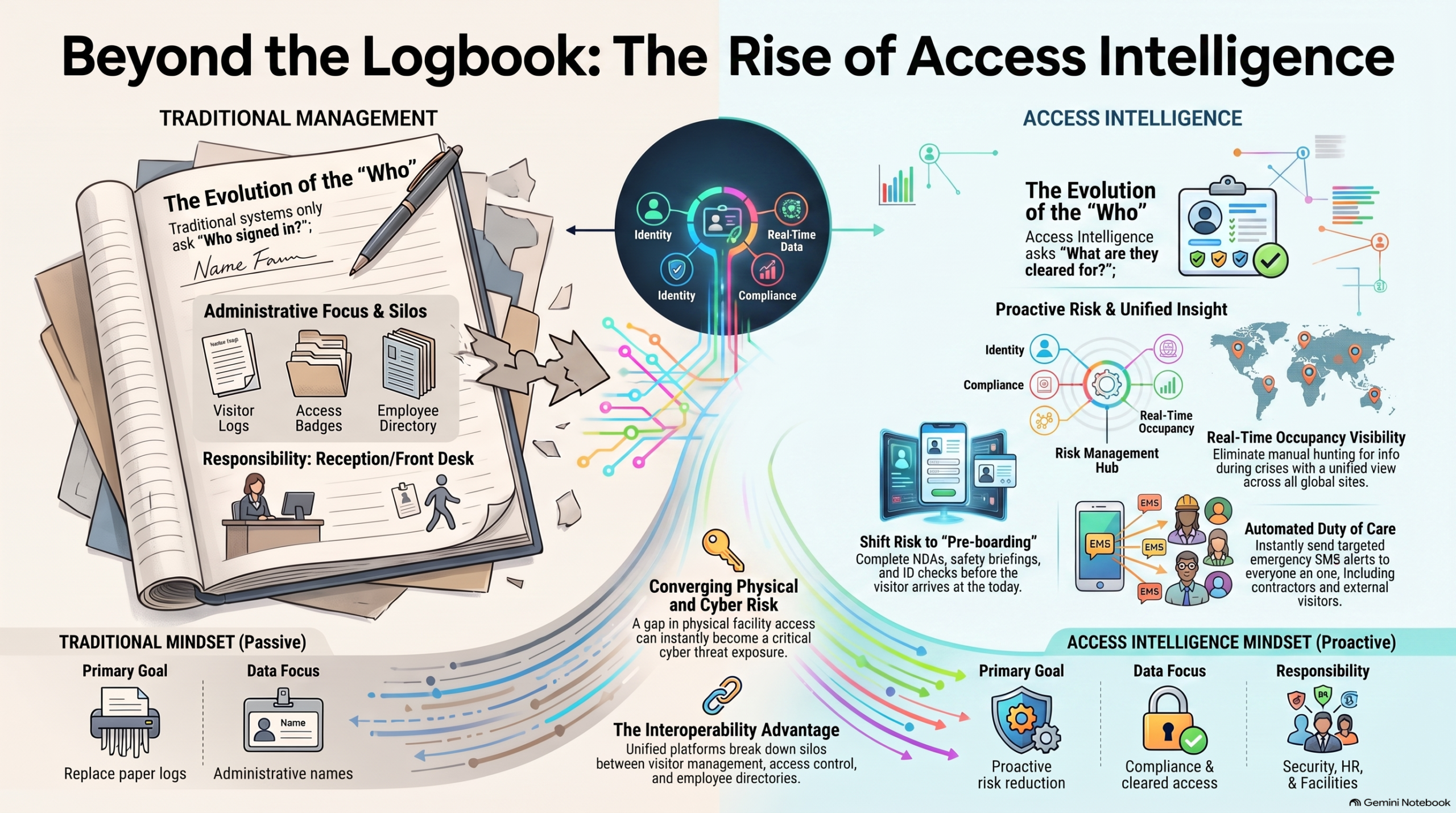
Traditional visitor management systems were designed primarily to answer a simple question: Who signed in?
Alex explains that modern organizations need answers to several additional questions. Who entered the facility? What are they authorized to access? Have they completed the necessary safety or compliance requirements? What does their presence mean in the context of other activity occurring across the organization?
This broader approach is what Sign In App calls “access intelligence.” It connects visitor activity with employee and contractor credentials, compliance requirements, access control, occupancy information, and workplace systems to create a more complete picture of who is entering an organization and what should happen next.
Physical and Cybersecurity Converge
The way organizations operate has changed dramatically. Hybrid work, geographically dispersed facilities, evolving compliance frameworks, and a growing dependence on contractors and other third parties have made manual processes increasingly difficult to manage.
At the same time, physical and cybersecurity risks are converging. A weakness in physical access can create a cyber threat, while compromised digital credentials can contribute to a physical security incident.
Alex discusses why organizations can no longer afford to manage visitor management, access control, workplace systems, and emergency communications as disconnected functions. Without meaningful interoperability, each system risks becoming another information silo.
Recognizing Risk Across Multiple Locations
Sign In App’s Unified Activity View and People Directory bring together activity and identity information from multiple locations.
This consolidated view can help security teams spend less time searching for information and more time acting on it. It can also allow an organization to recognize that a person involved in an incident at one location may attempt to enter another facility.
By connecting information across sites, organizations can establish appropriate controls, validate identities before arrival, and move from investigating incidents after the fact toward identifying and managing risks proactively.
Addressing Requirements Before Arrival
The front desk is often the worst possible place to discover that a visitor or contractor has not completed required training, signed an important document, passed an assessment, or received proper clearance.
Alex describes how visitor pre-boarding can move safety quizzes, policy acknowledgments, identity verification, background checks, nondisclosure agreements, and other requirements ahead of the visitor’s arrival.
This approach improves security and compliance while also creating a faster, less frustrating experience at check-in. Visitors arrive prepared, and organizations can address potential problems before those problems reach the lobby.
Improving Emergency Response
Real-time occupancy information becomes especially valuable during an emergency. Employees may already be connected to an organization’s internal communications, but visitors and contractors can easily be overlooked.
By knowing who is present and communicating with them directly, organizations can provide targeted instructions during evacuations, industrial incidents, severe weather, security threats, and other critical events.
Alex explains that the combination of accurate occupancy data and immediate communication can help turn a chaotic situation into a coordinated response while supporting an organization’s duty of care to everyone on-site.
Data Governance as a Core Capability
Greater visibility requires organizations to collect and connect more information, raising legitimate questions about privacy and data protection.
Alex argues that intelligence and responsible governance must be treated as inseparable requirements. Data should be encrypted, protected by strict access controls, available only to those who need it, anonymized when appropriate, and regularly audited by qualified third parties.
Rather than asking only whether more data should be collected, security leaders should determine whether the platform collecting it treats governance as a core capability instead of merely a written policy.
Connecting Existing Security Systems
Most enterprises already have access control, identity management, workplace, compliance, and communications systems. Replacing all of them is rarely practical.
The goal of access intelligence is therefore not to introduce another isolated system. It is to provide a layer that allows existing technologies and processes to communicate with one another.
Alex discusses the importance of integrations, open APIs, and connector ecosystems in eliminating manual gaps—because, as he observes, those gaps are often where risk thrives.
Trust, Verification, and the Future of AI
Organizations using visitor management strategically have moved beyond asking how to process people more quickly. They are asking what information should be collected, what that information reveals, and how it can support broader security, safety, compliance, and operational objectives.
Alex describes this as a “trust but verify” approach: organizations may trust that employees are inviting legitimate visitors, but they still need appropriate processes to confirm identity, authorization, and intent.
Looking ahead, Alex expects access intelligence to become less focused on collecting information and more focused on acting on it automatically. AI may help identify anomalies, recognize repeat visitors, and uncover patterns that could indicate risk before a human analyst knows to look for them.
Yet AI also makes it easier to impersonate identities, voices, faces, and messages. That erosion of digital trust may produce an unexpected countertrend: a renewed emphasis on face-to-face interaction and personal verification.
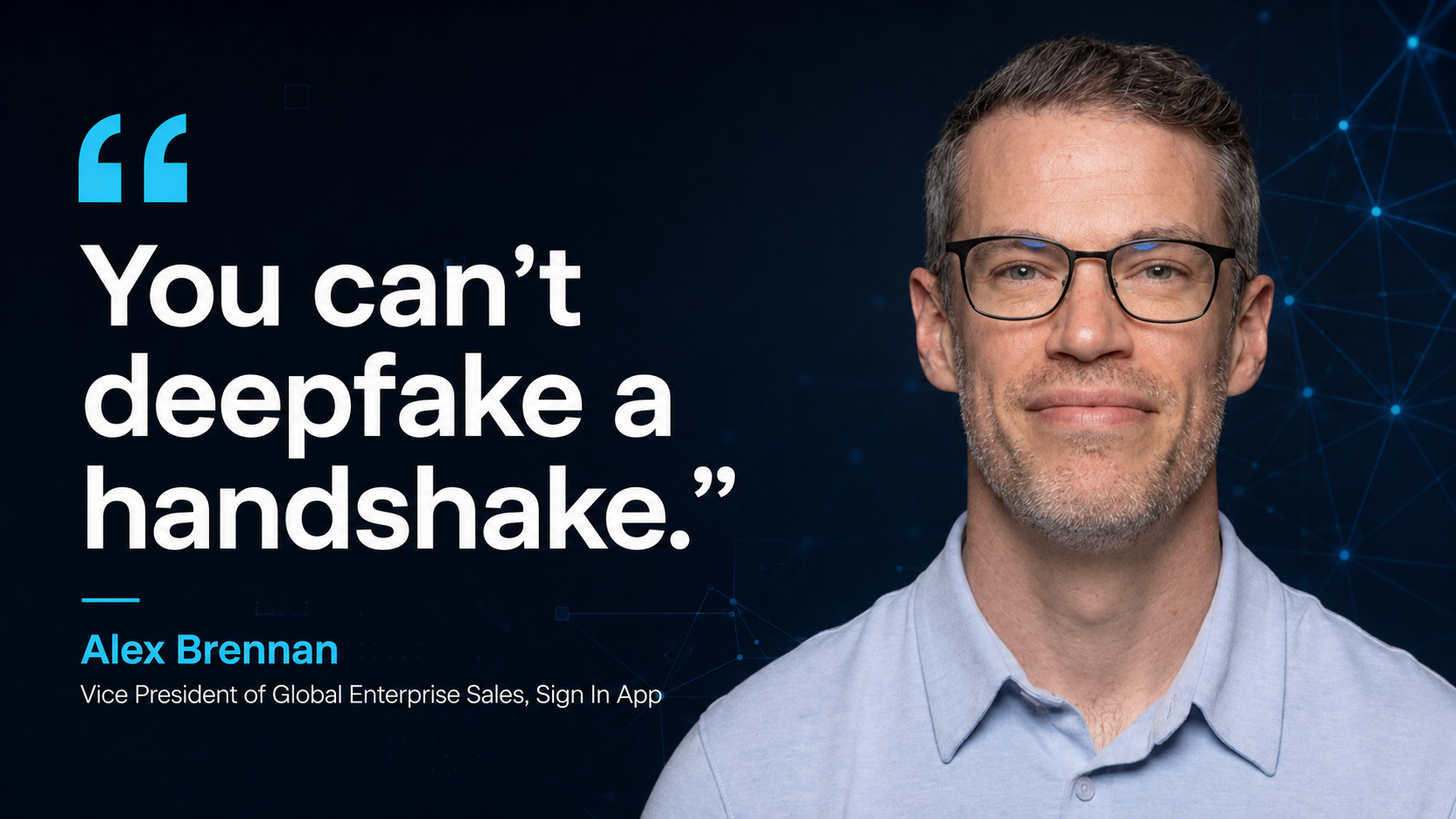
As Alex memorably puts it, “You can’t deepfake a handshake.”
Key Topics Discussed
- The difference between visitor management and access intelligence
- The convergence of physical and cybersecurity risk
- Unified visibility across multiple facilities
- Visitor and contractor pre-boarding
- Identity verification, safety training, and compliance
- Real-time occupancy data and emergency communications
- Privacy, encryption, access controls, and data governance
- Interoperability with existing enterprise security systems
- The “trust but verify” approach to physical access
- AI-driven risk detection and the future of in-person verification
Listen to the Episode
Click the image below to listen to the full episode.

About Our Guest

Alex Brennan is Vice President of Global Enterprise Sales at Sign In App, where he helps organizations worldwide elevate their visitor management and access strategies.
Based in Vancouver, Alex has contributed to the company’s growth for nearly a decade. He began with Traction Guest, leading enterprise expansion across key markets, and continued through its evolution into Sign In App.
Today, Alex plays an important role in expanding the platform’s global reach and advancing its mission to modernize physical security while creating safer, more seamless experiences for organizations.
Additional Resources
Video Overview
Infographic
About the Host

Steven Bowcut is the Editor-in-Chief of Brilliance Security Magazine and host of the Brilliance Security Magazine Podcast. Through conversations with security leaders, innovators, and subject-matter experts, he explores the technologies, strategies, and emerging issues shaping the future of physical and cybersecurity.